
Business Collaboration: NQCP and the POEM Technology Center
A collaboration between the Niels Bohr Institute and the French RIBER gives Denmark a place in the supply chain when it comes to the microchips of the future.

The University of Copenhagen has developed world-class expertise in nanofabrication for many years. This has resulted in a strategic collaboration that combines the research expertise of the Novo Nordisk Foundation Quantum Computing Programme and the latest production facility from the French company RIBER.
Local production of wafers
As a central component of the collaboration, Denmark has acquired its first facility with the capacity to produce wafers of the leading 300 mm standard. Wafers are the thin, ultra-pure slices of crystal material deposited on silicon, from which the chips are built, and which are grown in an advanced high-tech process.
“The new partnership can accelerate the development of future microchips in Denmark and Europe and thus help tackle the geopolitical and technological challenges that characterise the global chip industry. Hopefully, it will also position Denmark in the international market,” says Peter Krogstrup, CEO of NQCP and professor at the Niels Bohr Institute.
The new facility doesn’t just manufacture advanced wafers – it’s also being used to speed up the development of quantum chips. NQCP’s goal within the next 10 years is to develop the technology needed to build large, efficient quantum computers. And to do that, researchers need to be close to wafer production.
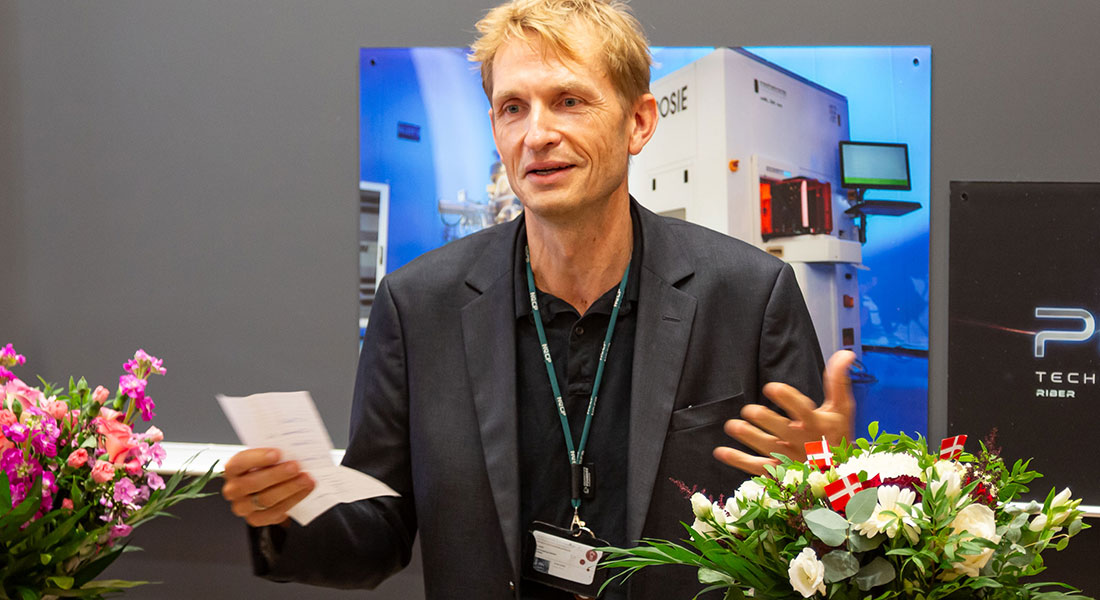
Much more efficient production of photonic chips
The special machine, which is the heart of the new facility, specializes in making photonic chips – i.e. light-based chips – which constitute the future solution within high-speed communication, optical data processing and also photonic quantum circuits.
The method used by the machine is called molecular beam epitaxy, and it makes it possible to deposit extremely thin layers of atoms on the wafers with enormous precision and purity. And it is precisely this precision and purity that makes it possible to also produce quantum chips on the machine.
“With the facility, we are moving the materials production in-house, which means that we can research and develop much more efficiently, because we are not dependent on having to ask others out in the world to produce for us. In addition, it helps us to be able to send the technologies that we develop directly into mass production - for the benefit of ourselves, for Denmark and the entire field,” says Peter Krogstrup.
The POEM facility is open to industrial partners who want to manufacture prototype chips for research and innovation purposes. The facility is located in the new Niels Bohr Building, where the daily operation will be handled by engineers and technicians from NQCP and RIBER.
“POEM is an example of how Danish research and European industry can collaborate to solve key high-tech challenges. We will benefit greatly from RIBER’s advanced equipment, and in turn they will tap into the first-class technological expertise we have built up here at the institute over many years,” says Joachim Mathiesen, head of the Niels Bohr Institute.
Several key Danish players are contributing to the project, including DTU Nanolab, NATO Diana and Aarhus University, with the aim of strengthening the national ecosystem within advanced microchips and quantum technology.

Topics
Contact
Peter Krogstrup, Professor
Email krogstrup@nbi.ku.dk
Phone: +45 26 71 51 91