
European Research Council (ERC):
18 September 2026
ERC Grants for three NBI researchers
Grants
José Maria Ezquiaga, Shingo Kono and Kasper Heintz have received the prestigious ERC starting grants to enable them to start their own research groups. Huge congratulations from NBI!

Jose María Ezquiaga: FurthestBBH
The elusive “dark matter” shapes the cosmic structures and the Universe expands at a rate that we struggle to understand. Answering these fundamental questions demands a deeper look into the distant cosmos. The project FurthestBBH (Furthest Binary Black Holes) proposes to use gravitational waves from stellar mass binary black holes to map the dark matter and test the foundations of gravity. “If we can recover these lensed signals from binary black holes, we gain a cosmic magnifying glass to observe the most distant black hole mergers and illuminate their origins”, says Jose María Ezquiaga, PI on the project and recipient of the ERC Starting Grant 2026.
Methods
By synthesizing groundbreaking advancements in theory, simulations, and data analysis the project will, hopefully, uncover the discovery potential of the furthest binary black hole mergers through
1. Pioneering the detection of lensed gravitational waves,
2. Unveiling high-redshift populations of compact binaries,
3. Probing dark matter substructures.
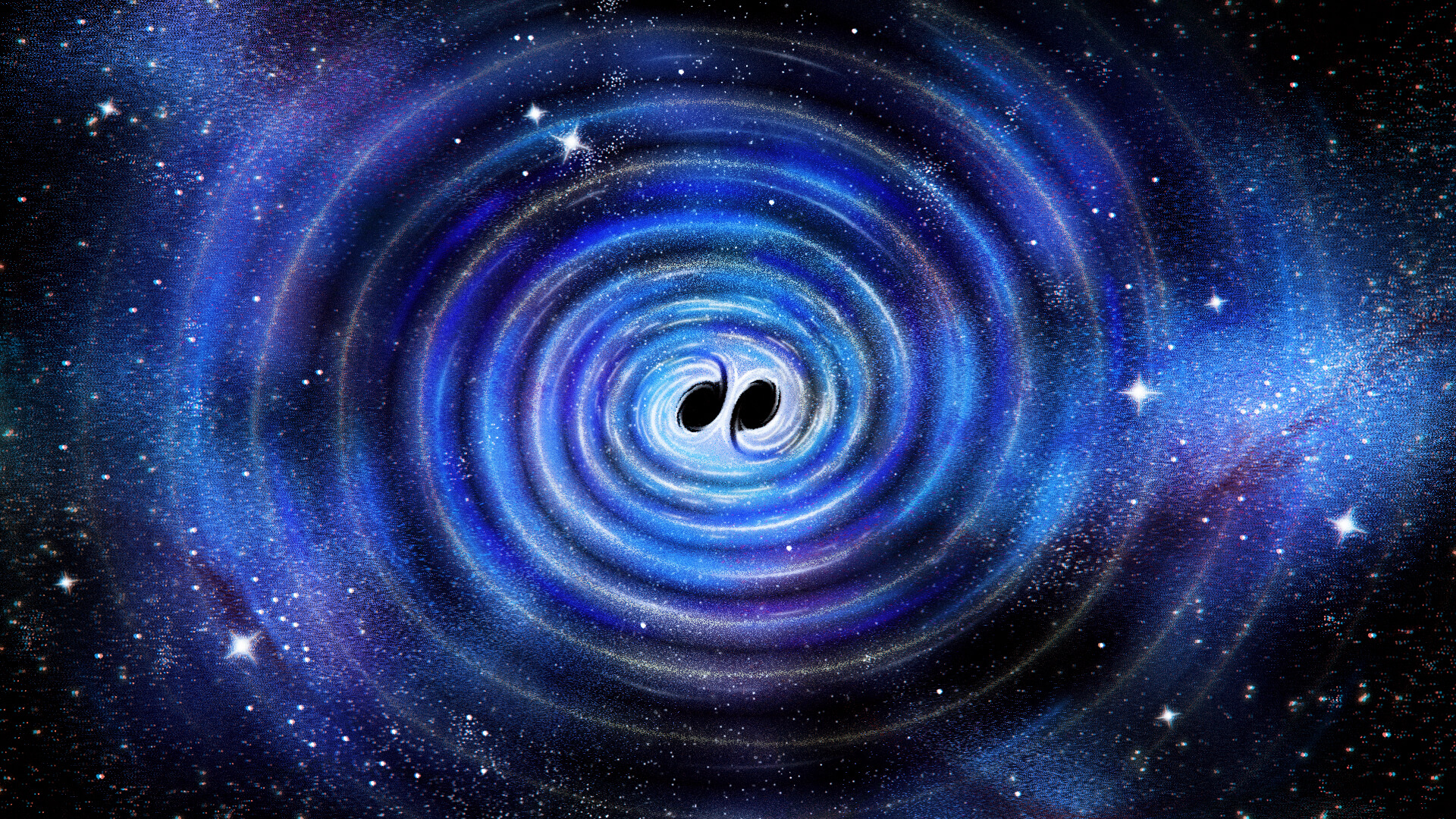
Ringing Black Holes: When two black holes collide and merge, they release gravitational waves. These waves can be detected by the LIGO-Virgo-KAGRA detectors on Earth, allowing scientists to determine the mass and spin of the black holes. The clearest black hole merger signal yet, named GW250114, recorded by LIGO in January 2025, offers new insights into these mysterious cosmic giants. Credit: Maggie Chiang for Simons Foundation
Impacting multiple fields along the way
The project is expected to impact multiple fields as well: Exploring gravity in the uncharted wave-optics regime; modeling lensing by substructures from cluster scales to subhalos; developing efficient machine-learning algorithms for detecting distorted waveforms; and constructing precise, unbiased astrophysical and cosmological population inferences that incorporate lensing.
FurthestBBH will enable the discovery of gravitational waves beyond current detection horizons, paving the way for next-generation observatories and revealing the transformative science of the most distant black holes.
One postdoc and two PhD students are expected to be employed at the project.
Shingo Kono: Q-MEMS
Quantum systems are, by definition, very small – in rough terms you could say that when you get below a certain level in (macroscopic, classical world physics) size, that’s where the quantum regime starts to have its say. Nevertheless, mechanical, macroscopic systems occupy a unique position at the boundary between the quantum and classical worlds. Observing macroscopic quantum phenomena in themselves is of fundamental interest but they also promise versatile applications, extending mechanical-oscillator technologies such as MEMS into the quantum regime. Perhaps one could say that mechanical systems provide a bridge between classical and quantum.
The Q-MEMS project has a specific target: The key milestone is to realize an ultra-coherent mechanical oscillator and coherently couple it to a strongly nonlinear quantum system, such as a superconducting qubit.
It is no small engineering feat – so how is it done?
Shingo Kono and his colleagues are introducing advanced fabrication technologies for scalable quantum computing to fundamental research to realize hybrid quantum systems of superconducting mechanical membranes and superconducting qubits. Finally, they are coherently coupling superconducting qubits to mechanical membranes by applying a novel quantum operation.
Even though existing circuit optomechanical techniques can bring mechanical systems into the quantum regime, the achievable quantum mechanical states are limited to trivial quantum states.
“But by using superconducting qubits, we can, in principle, prepare qubit states or Schrödinger states, which bring quantum advantages to mechanical membranes for many applications, including quantum computation, memory, sensing, and communications. More excitingly, if you could prepare Schrödinger states in such ultra-coherent mechanical membranes, these membranes start to be sensitive to gravitational effects, providing a new experimental platform to study the role of gravity in quantum mechanics”, says Shingo Kono.
One postdoc and two PhD students are expected to be employed at the project.
Kasper Heintz: PRIMORDIAL
Roughly 13.8 billion years ago, the Universe was filled with cool, neutral hydrogen gas — the primordial material left over from the Big Bang. Over the following billion years, this gas collapsed gravitationally to form the first stars and galaxies, whose intense, ultraviolet light gradually stripped the electrons from the surrounding hydrogen atoms across the whole Universe. This process, known as the epoch of reionization, is considered the last great phase transition in the history of the cosmos.
What makes this epoch hard to study is that the same neutral hydrogen plays two opposing roles at once: it is the raw fuel that stars are made from, but it also acts as a fog that blocks most of the light that stars produce. The neutral gas cannot be observed directly in emission around individual galaxies at these enormous distances, and hence astronomers have lacked a way to directly connect the earliest, nearly featureless Universe (as seen in the cosmic microwave background) to the first galaxies we can actually observe.
“I am extremely excited to now have the capabilities, using some of the largest ground- and space-based telescopes every built, to start answering some of the perhaps most fundamental questions: Where did we come from? How did it all start?”, says Kasper Elm Heintz.
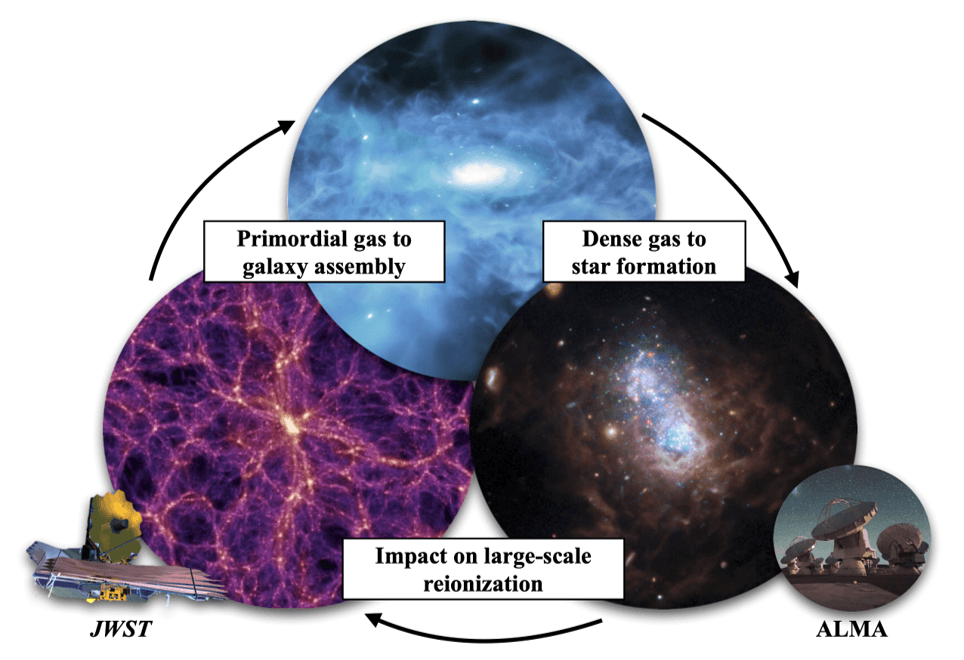
Heintz and his group at the Cosmic Dawn Center at NBI and DTU have pioneered a new way around this problem. Using JWST, they have identified the clearest evidence yet of extremely dense reservoirs of this primordial gas surrounding some of the very first galaxies, seen as they were just 400 million years after the Big Bang. Combined with new methods using ALMA to trace neutral gas indirectly through far-infrared light, the PRIMORDIAL project will build the first large, statistically robust census of this primordial hydrogen: where is it located, how much is there, and how does it shape both star formation and the escape of light that ultimately reionized the Universe.
The project is organized around three work packages: mapping hydrogen gas around individual galaxies in the first billion years, identifying and characterizing dense clusters of galaxies during this era, and using ALMA to “weigh” the total amount of hydrogen gas surrounding typical galaxies at these early times. Together, these studies aim to resolve some of the biggest current puzzles unveiled by JWST, including why the earliest galaxies appear brighter and more massive than expected.
One Postdoc and two PhD students are expected to be employed at the project.
NBI wishes to congratulate all recipients with their ERC grants and look forward to seeing their ideas come into full bloom over the next 5 years!
Contact
Søren Jønsson Granat
Communications officer
granat@adm.ku.dk