
Global Neutrino Network Dissertation Prize goes to Tetiana Kozynets, former Ph.D. at NBI.
Tetiana “Tania” Kozynets has been awarded the 2025 Global Neutrino Network (GNN) Dissertation Prize for the Ph.D. thesis she completed at the Niels Bohr Institute. Three awardees received the prize and the winners were announced at the recent GNN meeting in Amsterdam.
The prize is a recognition of young postdoctoral candidates who have written outstanding theses and contributed significantly to neutrino physics and astronomy.
Her advisor, Associate Professor Jason Koskinen of the Niels Bohr Institute, praised the recognition: "Tania's thesis work was characterized by the same rigor and creativity she brings to everything she does. This award reflects not just the strength of her science, but the care she takes in explaining why it matters — both to her colleagues and to the public. We're incredibly proud to see her work recognized at this level."
Sharing her excellent work with the scientific community has, apparently, not been enough for Tania. At The Niels Bohr Institute, she has taken time out of her busy work schedule to take part in a multitude of outreach activities, in order to share the newest and most exciting progress on neutrino research with a much wider audience. A good example is Culture Night, an annually recurring outreach event in Denmark, Tania has spent a lot of time planning, giving talks and talking to the more than 2000 visitors per night, doing her best to pass along her enthusiasm for science.
Tania explains here about the not so straight line from ideas to results in the PhD project:
“I was delighted to find out that I had received the GNN prize this year. My PhD research was a mix of experiment and theory, first-principles modelling and statistical analysis, neutrino mixing phenomenology and the depths of Monte Carlo simulation… Putting it all together into a single document was a challenge in its own right.
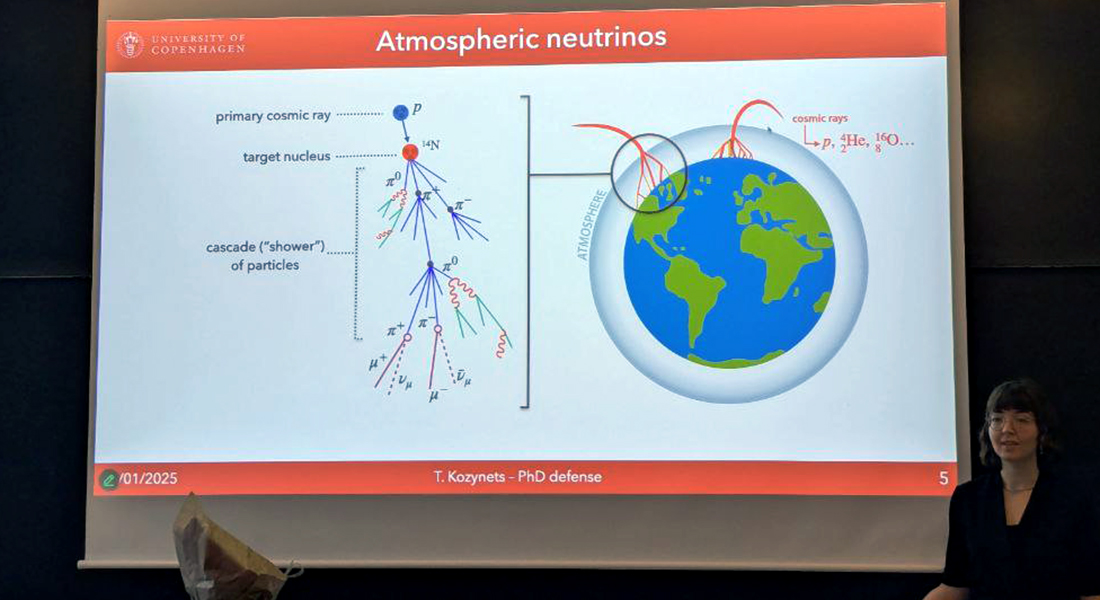
Starting with why neutrino mixing unitarity was the measurement we wanted to make, then going into how one makes such a measurement using atmospheric neutrinos, and finally, facing a big practical question: Do we know our detector well enough to be able to do it? I am very glad to see that the thesis that emerged from this holistic approach was recognized by the GNN board, and I hope it can serve as a good example of bridging theory and experiment.
I want to thank Jason Koskinen, Tom Stuttard, and Philipp Eller for being such incredible mentors and scientists to work with and learn from, as well as the IceCube Collaboration for providing such a fantastic particle physics instrument and a platform for a young researcher to grow”.
At the Niels Bohr Institute we congratulate Tania with the prize and wish her all the best in her new postdoc position at the University of Liverpool – and we are a little envious of them.