
Nobel Prize in Physics goes to IceCube pioneer Francis Halzen
Researchers at the Niels Bohr Institute, which has been part of IceCube since 2013, congratulate Francis Halzen on being awarded the Nobel Prize in Physics. To the researchers at NBI, Francis Halzen is a colleague and friend whose vision has opened a new window on the universe.
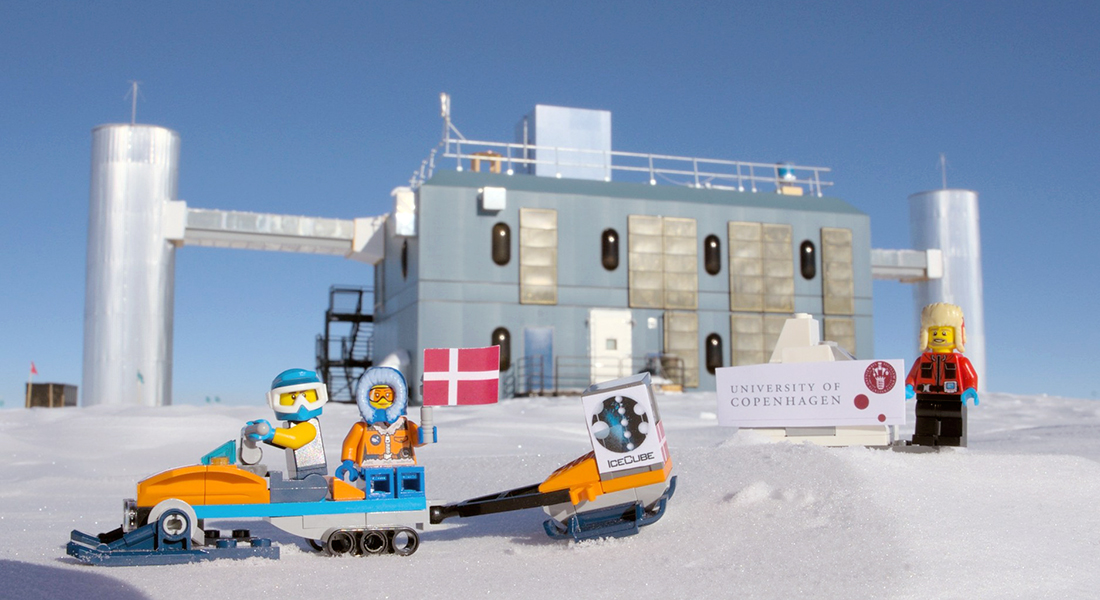
The IceCube group at the Niels Bohr Institute (NBI), University of Copenhagen, congratulates Francis Halzen on the 2026 Nobel Prize in Physics. The prize goes to Halzen alone, though he is the first to say that many talented people joined him on the journey. Among the IceCubers, past and present, more than a few will be celebrating today as if a small corner of the medal were theirs too.
In 1988 Halzen and a colleague proposed using the deep, clear ice of Antarctica to detect neutrinos, the nearly massless "ghost particles" that pass through almost everything in their path. The idea became the IceCube Neutrino Observatory: more than 5,000 light sensors frozen into a cubic kilometre of ice, 1.5 to 2.5 km below the South Pole. In 2013 IceCube reported the first evidence for high-energy neutrinos from beyond our solar system. Mark Pearce, chair of the Nobel Committee for Physics, credited Halzen's tenacity and vision with paving the way for a new kind of astronomy.
"IceCube has helped break the monopoly that light has had on observing the universe for thousands of years," says Troels Petersen, Associate Professor at NBI and IceCube member. "We can now see the universe in a whole new way and begin to solve some of its riddles. Francis Halzen made this possible."
A brilliant scientist and mentor
Markus Ahlers, Associate Professor at NBI and IceCube member, worked closely with Halzen earlier in his career as a John Bahcall Fellow at the University of Wisconsin–Madison.
"I cannot imagine anyone more deserving of a Nobel Prize for neutrino astronomy," says Markus Ahlers. "Francis is a brilliant scientist, a great mentor, and a constant source of inspiration for me and my colleagues."
He stresses that the field is still young: "As Francis said at the announcement, neutrino astronomy is only beginning, and there is more to come. We only recently discovered a neutrino glow from our own Milky Way."
Denmark in IceCube since 2013
NBI became a full member of the IceCube Collaboration in October 2013, the first Danish institution to join, weeks before the collaboration announced its first astrophysical neutrinos. The NBI group works on both experiment and theory, from neutrino oscillations and the IceCube Upgrade to the search for cosmic neutrino sources.
"When Denmark joined IceCube through NBI in 2013, we were just starting to see neutrinos that could be used for astronomy," says D. Jason Koskinen, Associate Professor and head of the IceCube group at NBI. "Thirteen years later, we observe the wider universe with high-energy neutrinos and get to celebrate Francis's Nobel Prize. It is a moment built on years of hard work."
In January 2026 IceCube was upgraded with new sensors deep in the ice. "The Upgrade gives us IceCubers a new opportunity to build on the pioneering work and example set by Francis," says Jason Koskinen. "Like the many IceCube groups around the world, we at NBI look forward to opportunities that exist only because of his vision."
Looking ahead
For Markus Ahlers, the prize looks forward as much as back.
This year's Nobel Prize recognises the importance of Francis's work for our field"
Contact
D. Jason Koskinen, Associate Professor
IceCube Institutional Lead, Niels Bohr InstituteNiels Bohr Institute, University of Copenhagen
Email: koskinen@nbi.ku.dk
Markus Ahlers, Associate Professor
Niels Bohr Institute, University of Copenhagen
Email: markus.ahlers@nbi.ku.dk
Troels Petersen, Associate Professor
Niels Bohr Institute, University of Copenhagen
Email: petersen@nbi.ku.dk