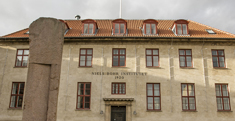
Broad and comprehensive quantum research at NBI
Research in quantum physics has long received a great deal of attention internationally and at the Niels Bohr Institute at the University of Copenhagen, research has been conducted in modern quantum physics since 2003 when Professor Eugene Polzik established the Center of Excellence ‘QUANTOP’. Here they managed to teleport information from light to light .... >>
...
and later between two clouds of caesium gas – a breakthrough that will be very important for the future development of ultra-precise measuring instruments for, among other things, hospital equipment. Another area of research is to improve the sensitivity of the best motion detectors, namely the gravitational wave interferometers, which reported the first observation of gravitational waves in 2017.
Jan W. Thomsen, Head of the research group ‘Quantum Metrology’ at the Niels Bohr Institute and Head of Department since September 2017, has also researched precision measurements with ultracold atoms, resulting in an atomic clock that only loses a second in 13 billion years. With such a precise measuring device it is, for example, possible to measure displacements in the Earth’s crust and could possibly be used to predict earthquakes. Atomic clocks are also found in the GPS satellites used for positioning on the ground.
Peter Lodahl is the Head of the group ‘Quantum Photonics’, which, among other things, focuses on producing photonic chips that could be used for quantum technology based on light (photons). With regards to this, they have partnered with the private sector and the group is also part of the nationwide ‘Qubiz’ project funded by Innovation Fund Denmark. Peter Lodahl is also the Head of a new Center of Excellence, which will aim to develop the internet of the future – a quantum internet. The new research center ’Center for Hybrid Quantum Networks’ (Hy-Q) was officially opened 17 September 2018.
Anders S. Sørensen is the Head of the research group ‘Theoretical Quantum Optics’, which develops theories for how to develop quantum information technologies in practice. To achieve this, the group researches a wide variety of physical systems from individual atoms, ions and photons to mechanical vibrations and superconductors in solid-state systems. In particular, the group is interested in quantum communications over long distances. The group is also part of the newly launched ‘Center for Hybrid Quantum.
