
Astrophysics
26 February 2026
James Webb finds surprisingly mature galaxies in early cosmic megastructure
The early Universe:
New research shows that some of the most massive galaxy groups have evolved more rapidly than anticipated. The galaxy group known as “The Cosmic Vine” contains far more inactive galaxies than previously observed – a characteristic normally associated with much more mature galaxies. The research is led by PhD student Nikolaj Silassen and has now been published in Astronomy and Astrophysics.
Using the powerful James Webb Space Telescope, an international team of researchers led by a Danish astronomy student at the Cosmic Dawn Center in Copenhagen showed that some of the most massive galaxies in the early Universe were evolving more rapidly than expected.
Studying a recently-discovered enormous galaxy cluster, the "Cosmic Vine", the astronomers found that the huge structure hosts many additional galaxies, including several massive “dead” galaxies that have already stopped forming stars.
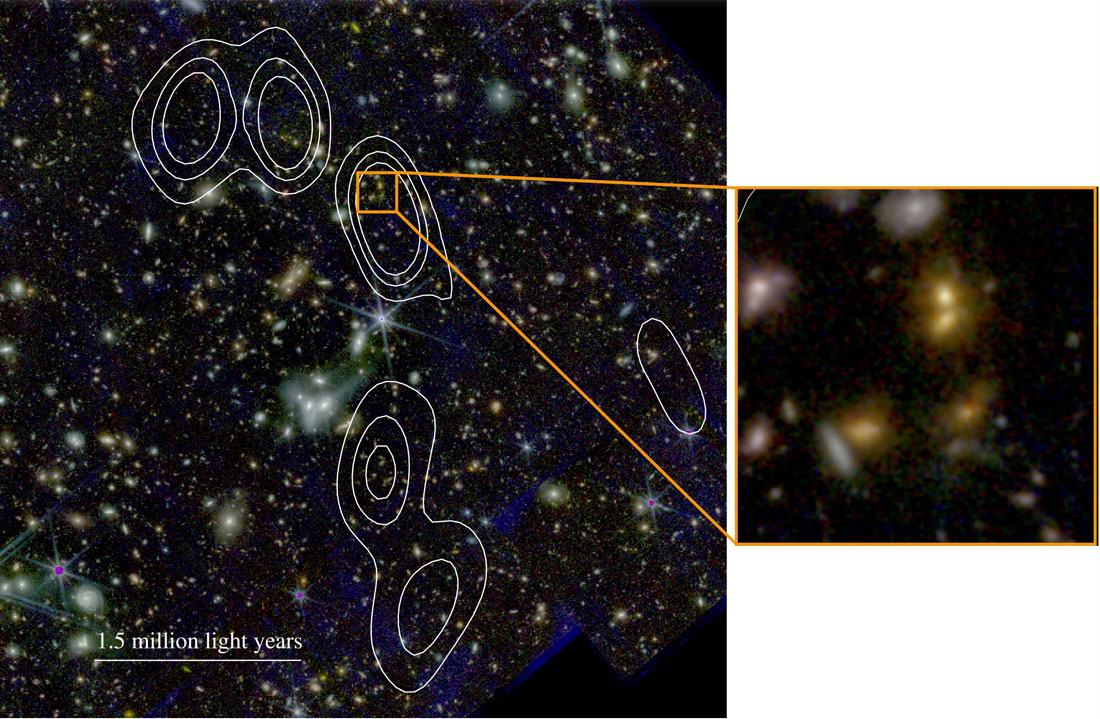
A view of the central part of the Cosmic Vine, spanning a few million light years. The white lines show the distribution of the galaxies which make up the structure. The zoom-in shows the core of the proto-cluster, which hosts a pair of massive merging quiescent galaxies, and two dust rich star-forming galaxies. The Cosmic Vine is located in the constellation of Ursa Major. Credit: Sillassen et al. (2026).
Massive galaxy clusters, huge collections of hundreds or thousands of galaxies, are the largest gravitationally bound structures known. Over billions of years, they slowly assemble from smaller groups, as galaxies are attracted toward a common center.
Catching them in the act of formation allows astronomers to test how quickly galaxies grow, shut down star formation, and settle into the orderly systems we see today. Now, new observations of one such structure are challenging expectations.
A surprisingly large population of “dead” galaxies
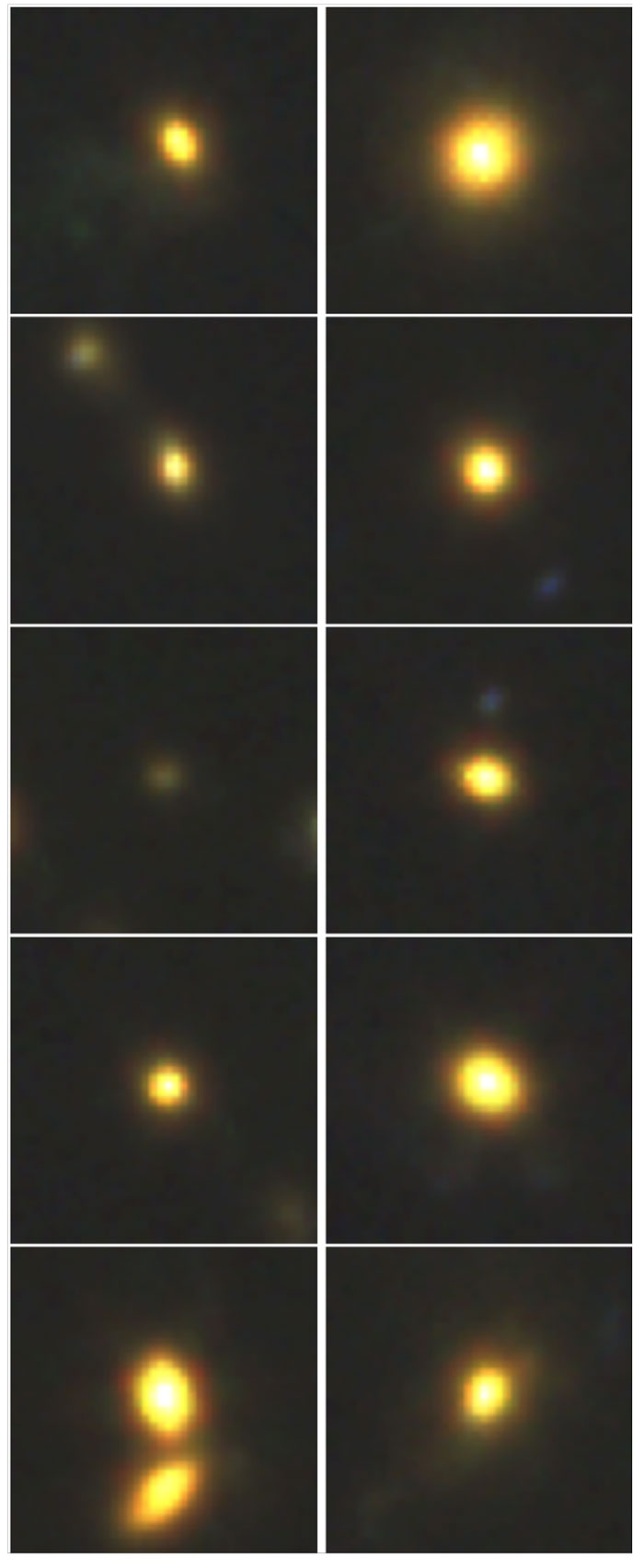
Cutouts of the 11 quiescent galaxies discovered in the Cosmic Vine. Credit: Sillassen et al. (2026).
One such megastructure, discovered back in 2023, is a galaxy cluster dubbed the "Cosmic Vine" due to its galaxies' resemblance to grapes on a vine. This cluster is seen as it was just 1.8 billion years after the Big Bang — about 13% of the Universe’s current age.
Now an international team of researchers, led by astronomers at the Cosmic Dawn Center (DAWN) at DTU Space and the Niels Bohr Institute in Copenhagen, has identified 11 "dead", or quiescent, galaxies inside the Cosmic Vine. That is, galaxies that have for some reason ceased to form new stars. This is the largest known sample of quiescent galaxies ever discovered in such a young structure.
The discovery was made thanks to new data acquired by the James Webb Space Telescope and a large database of all of James Webb's spectroscopic data, the "DAWN JWST Archive", curated by the Cosmic Dawn Center.
Interestingly, the analysis of the galaxies showed a remarkable feature. When the researchers plotted the galaxies by color and brightness, they found a clear “red sequence” — a tight band of red, non–star-forming galaxies usually seen only in more developed galaxy clusters in the nearby Universe.
"Plotting the brightness and colors of galaxies is standard procedure when analyzing a sample of galaxies," explains Nikolaj B. Sillassen, PhD student at DAWN and leader of the study. "But in this case the data formed a well-defined red sequence, a feature typically seen in mature galaxy clusters in the late-time Universe. This early appearance of a red sequence suggests that the Cosmic Vine is already well on its way to becoming a fully formed galaxy cluster".
The team also found that the Cosmic Vine contains more quiescent galaxies than expected, compared with galaxies found elsewhere in the early Universe.
“The large population of quiescent galaxies tells us the Cosmic Vine is maturing faster than expected for a structure this young,” says Shuowen Jin, Marie Skłodowska‑Curie fellow at DAWN and mentor on the project.
Unveiling the dark side of forming clusters
In total, the researchers confirmed 136 galaxies as members of the Cosmic Vine, making it one of the richest early structures ever observed.
From their distribution, the team identified four substructures, spread over an area of 4.7 by 3.0 million light years, plus two foreground groups, nicknamed the Cosmic Leaf, located about 65 million light years closer to us. Each substructure is a small galaxy group, which will likely merge with the core of the forming cluster in the future.
“Most of the mass in these systems is in the form of invisible dark matter”, says Nikolaj B. Sillassen. “We need to understand not only the galaxies in proto-clusters, but also the dark matter that binds them together, to better understand the nature and fate of structures like the Cosmic Vine.”
By applying several complementary advanced techniques, the team estimated the dark matter content of each substructure. They found that the proto-cluster core contains ten times more dark matter than any of the smaller subgroups.
Comparisons with advanced simulations show that the Cosmic Vine is on track to grow into one of the most massive galaxy clusters in the early Universe.
Contact
Nikolaj Bjerregaard Sillassen, Ph.D-student
E-mail: nbsi@space.dtu.dk
Shuowen Jin, Postdoc
E-mail: shuji@space.dtu.dk
- Publication: Sillassen et al. (2026): Cosmic Vine: High abundance of massive galaxies and dark matter halos in a forming cluster at z = 3.44
- A preprint is available: https://arxiv.org/abs/2510.23549
The study has been published in the scientific journal Astronomy & Astrophysics.