
Longstanding Quantum communication barrier broken
Researchers at the Niels Bohr Institute have broken a long standing barrier by managing to send single photons - that can’t be copied or split and thus are secure - in the network of optical fibers we already have. This opens up a broad range of applications relying on secure Quantum information.

Signal loss in optical fibers
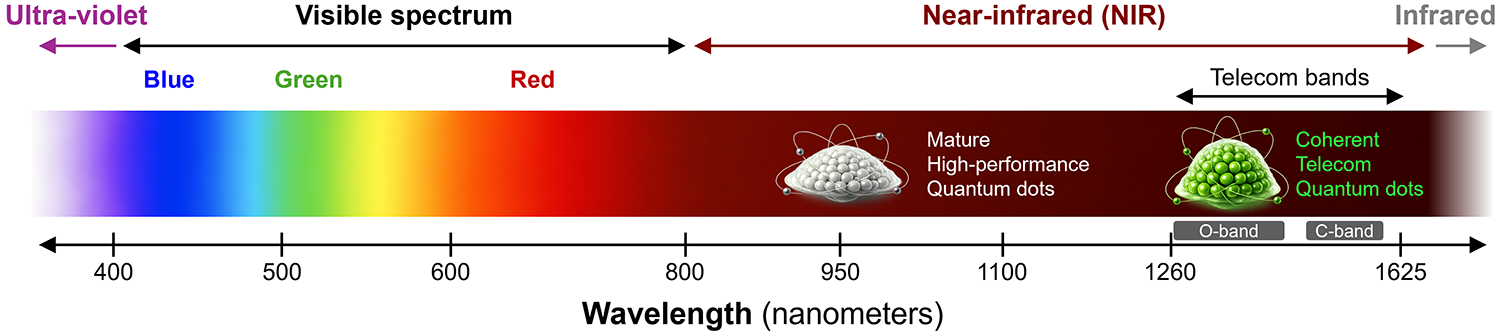
Quantum dots are unsurpassed in their ability to generate coherent single photons - single particles of light, which cannot be split or copied and therefore are secure for quantum communication. So far, the problem was that the best quantum dots only worked around 930 nm wavelengths, which is far short of the telecommunication compatible wavelengths starting at 1260 nm. Only these longer wavelengths can be used to distribute the information-carrying photons far and has so far been restricted to sub-optimal platforms.
Now, scientists have managed to create a new type of quantum dot, which exploits the best of both worlds.
Noise is the enemy of everything quantum
Researchers working with quantum light sources have long attempted to work directly in the telecom band, but the photons produced at these wavelengths were always very noisy, as Leonardo Midolo explains. “Noisy in this context means that you couldn’t generate one photon after another with the same properties. The photons need to be perfectly identical, and achieving this level of quantum coherence in the telecom band has proven extremely challenging”.
Two major challenges overcome
Leonardo Midolo and his team have succeeded in overcoming two major challenges in one go: their photons are now coherent and identical, and they are emitted directly in the original telecom band (around 1300 nm), the same wavelength used in today’s standard fiber-optic networks. This opens the door to linking photonic quantum technologies to the existing communication infrastructure.
For years, a kind of “accepted truth” circulated within the research community: yes, you can make photons in the telecom band, but they will be noisy and incoherent – which, as Leonardo notes, essentially meant “useless” for quantum applications. Their breakthrough challenges that assumption head-on.
This progress relies strongly on collaboration with the research group in Bochum, Germany, who optimized the growth of these ultra-low-noise quantum dot emitters.
“At the Niels Bohr Institute, we then use advanced nanofabrication in our cleanroom to pattern these materials into quantum photonic circuits,” adds Marcus Albrechtsen, joint first author of the study. “We fabricate nanochips and probe them with lasers at low temperatures to confirm they emit highly coherent single photons.”
Extras for free
Just as important – a kind of icing on the cake - is the fact that photonic integrated circuits, chip-scale optical circuits that miniaturize complex optical setups, are commonly made in silicon. It is the most common, cost-effective material for controlling and routing light on a chip. However, silicon absorbs much of the light in wavelengths below 1100 nanometers, which has so-far precluded the integration of near-infrared emitters like quantum dots in these photonic chips. This means that if you can make your photons coherent, identical, and operate at 1300 nm you can directly embed quantum-grade light sources with commercial silicon photonic chips.
It opens up a lot of possibilities, possibilities that were long considered out of reach.”
What happens now?
This achievement effectively removes one of the biggest roadblocks to build real, large‑scale quantum networks. It means quantum chips, quantum repeaters, and long‑distance quantum communication can now be built on top of the world’s existing fiber infrastructure. No complicated workarounds like nonlinear frequency conversion. Just plug‑and‑play quantum technology. In short: the door to a functional quantum internet is now officially open. And with this platform in hand, the race is on to build the first scalable quantum network.
The result is now published in Nature Nanotechnology https://doi.org/10.1038/s41565-026-02156-7
Contact
Marcus Albrechtsen
m.albrechtsen@nbi.ku.dk
+45 30 69 64 87
Leonardo Midolo
midolo@nbi.ku.dk
+45 23 23 41 69
Søren Jønsson Granat
Communications Advisor
+45 35 32 06 05