
Bachelor Project:
2 February 2026
Neutron scattering techniques applied to dental fillings promise cheaper bills
Condensed Matter Research:
When most people think of neutrons, they picture atomic particles buried deep in physics textbooks. However, a new study reveals how these tiny, invisible particles can be utilized to enhance our daily lives.
The Trouble with a dental filling
When you get a dental filling, the dentist uses a soft, paste-like material that hardens and becomes a strong filling under a bright blue light.
But suppose that this "light-curing" process is not ideal: the materials’ chemistry is suboptimal, there is a problem with the light source, or maybe the dentist makes a mistake. In those cases, the filling turns out to be weaker, it wears down faster and can even leak unreacted chemicals that may irritate our soft tissues.
Today, the linking of individual molecules into a chain of molecules (i.e., polymer formation) is not complete in any resin-based dental material, leaving plenty of room for improvement.
How Neutrons Can Help
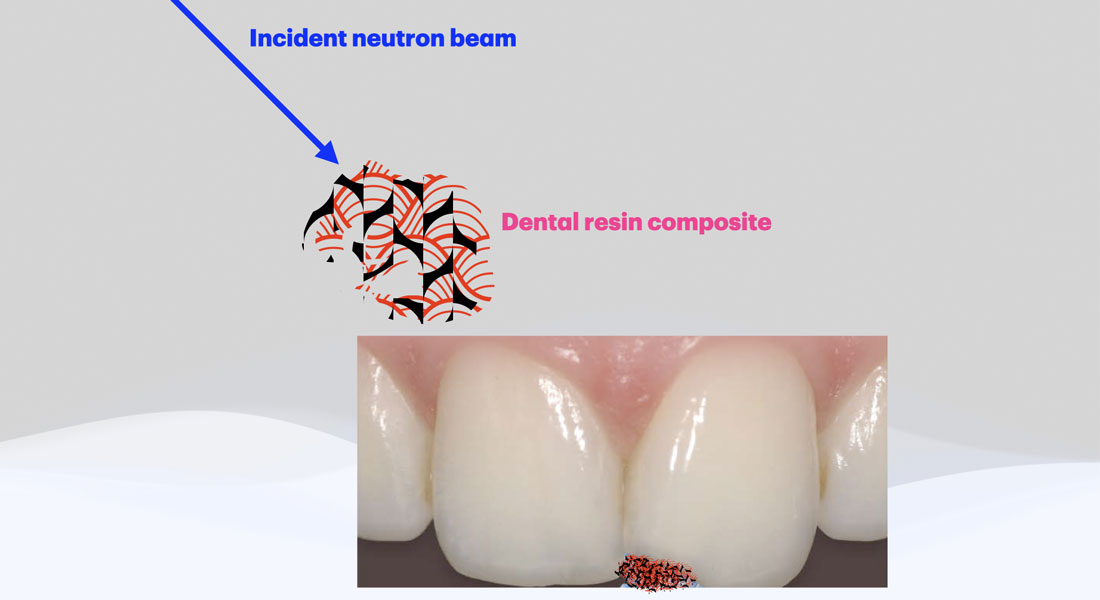
Neutron spectroscopy is a powerful method to analyze materials. When a travelling beam of neutrons hits and interacts with the molecules in the material, the neutrons are spread out.
By analyzing the trajectory angle and speed of neutrons as they are scattered away from the material, we can calculate the extent and type of molecular motions. Neutrons are uniquely sensitive to the smallest atom — hydrogen — which is abundant in tooth filling materials.
Thus, neutron spectroscopy makes it possible to describe exactly what is happening at a molecular level by following how the hydrogen atoms move, and mapping the material’s structure as it hardens, yet without destroying the sample.

Neutron scattering “sees” the change in the material taking place
By comparing the tooth filling materials before and after the blue light was applied, dramatic structural changes were detected. Before light-curing, the molecules in the materials were flexible and moved freely.
After curing, the molecular motion almost stopped, forming a rigid, stable network. This is the signature of the degree of conversion from a soft paste to a hard composite-based material.
Everyday Impact for everyone
This research, published in Polymer, provides a new window into improving dental materials. By understanding the exact nanoscale dynamics of the hardening process, we can work to design smarter, longer-lasting, and safer dental fillings.
We could, for instance, modify the materials’ chemistry or better yet, the process we use to harden the materials.
Dental filling improvements could mean cheaper dental bills – for you
Neutron scattering can help us achieve the ultimate "recipe" for the optimal cure of light-cured filling materials.
This means that future fillings offered by your dentist could become more durable and better for your overall oral health: a definite improvement on the cost-benefit of dental restorative treatment.