
Grants:
27 February 2026
Kathrine Mørch Groth receives a Villum International Postdoc grant to create an overview of neutrino sources in the Universe
Grants:
We are far from knowing all the sources of the countless neutrinos travelling through the universe. A new research project aims to change that, as these particles have much to teach us. They hardly interact with their surroundings – which means they may carry important, original information from cosmic events.
The neutrino is perhaps the most mysterious particle in the catalogue of elementary particles. They travel in vast numbers through the Universe, but interact only very weakly with their surroundings. Precisely for this reason, they can tell us something about the sources they originate from. And if we know the sources, the flow of neutrinos can be used to calibrate our understanding of the events that we know their emission must be consistent with. This includes direction, energy level, type of neutrino, and much more. But we need an overview of the sources – and this is where Kathrine’s project comes in.
Kathrine explains that the purpose of the Villum International Postdoc grant is to ensure that female researchers have the opportunity to pursue a research career. The grant focuses on enabling the establishment of an independent research profile with international experience. Kathrine’s project will therefore be carried out in collaboration with Stockholm University and the Oskar Klein Centre in Stockholm, as well as the Niels Bohr Institute.
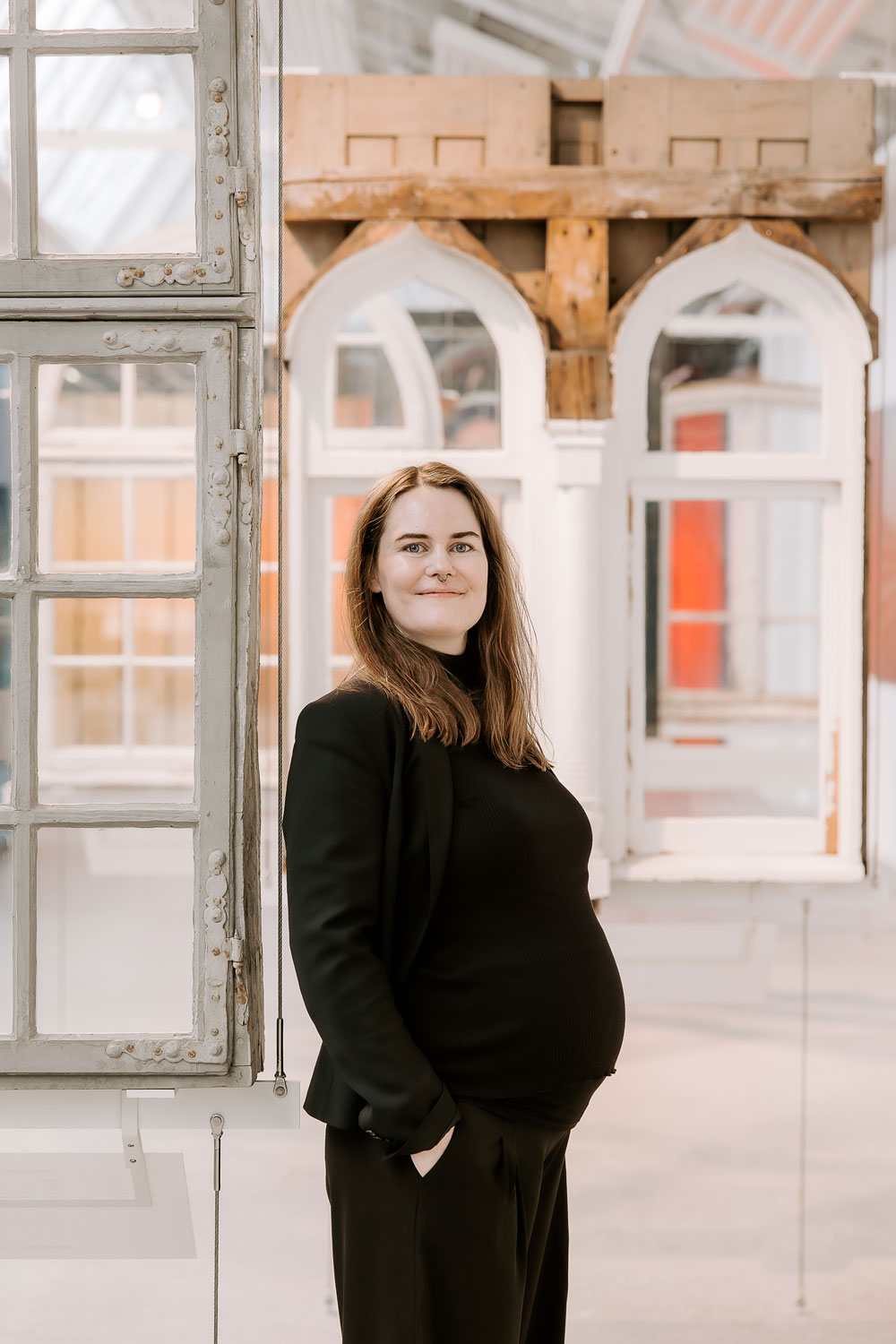
This year, 6 young researchers have been awarded the grant.
A unique project – the applicant assembles it themselves
Kathrine has designed her own project. That is part of the structure of the grant – your own timeline, your own budget, and your own vision for what can be accomplished in 3 years. Kathrine’s project forms a new research direction that builds on her PhD work carried out with Markus Ahlers at the Niels Bohr Institute, whom Kathrine describes as an excellent PhD supervisor. In the new project, Kathrine will explore the central open questions in neutrino astronomy.
Linking detections of neutrinos with their sources is the challenge
The neutrino sources present a problem: We have plenty of neutrino detections, but we have not seen neutrinos coming from the sources we expected. When we compare the known sources with what we can actually detect, there is no match. Both remarkable and incredibly fascinating, Kathrine says.
However, we do have strong evidence that some sources can produce many neutrinos – for example various active galaxies – but we do not yet have sufficient statistical certainty to call it a discovery. There are specific criteria that must be met to declare discoveries “statistically secure,” and that threshold has not been reached yet – only nearly.
We therefore need a better overview of what other objects and events might be out there that could produce neutrinos. And it seems likely that the answer is complicated – we may have many types of sources under many different conditions – because that is often how nature works. It is a big task, but it is precisely this overview that Kathrine has set out to create.
Networking will be crucial for success
Kathrine will draw on knowledge from many different directions. Many types of research will meet in an interdisciplinary space: modelling galaxies, measurements of cosmic radiation, and our own understanding of neutrino detection. Networking will be essential – and the research group at Stockholm University, the working groups at the Oskar Klein Centre, and the IceCube detector at the South Pole offer indispensable connections with many other researchers.
“The grant from the Villum Foundation provides me with a clear path forward in my research, enabling me, as I prepare to become a mother, to continue pursuing my career ambition and work towards leading my own research group,” Kathrine says. “At the same time, I am delighted that the foundation has placed its trust in my research project and its potential to advance our understanding of the high‑energy Universe and the rapidly evolving field of astroparticle physics.”