| Read more >>
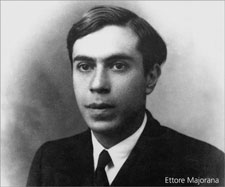
Majorana was born on August 5th 1906 in Catania, Sicily. It soon became evident that he was unusually gifted when it came to numbers and math – and at 17 he started studying engineering. After a few years, however, he switched to physics, a subject in which he mastered at University of Rome La Sapienza in 1929.
Following his graduation Majorana joined a group of young physicists working under Enrico Fermi. The group was known as the ‘Via Panisperna Boys’, named after the street address of their lab; Enrico Fermi – Nobel Prize winner in physics 1938 – emigrated to USA prior to WWII and became one of the key scientists behind the Manhattan Project which ultimately resulted in the atom bomb.
Majorana was known to be somewhat ‘quirky’ – certainly not a man to blow his own horn – and throughout his entire career he published just nine scientific articles. Yet his vast talent remained undisputed – Majorana was, as Fermi later put it, “a genius, like Gallilei and Newton”.
In 1933, the year Hitler and his national socialists seized power in Germany, Majorana received a grant which enabled him to go to Leipzig where he did some work with Werner Heisenberg – and also found time to pay Niels Bohr a work-related visit in Copenhagen.
Upon returning to Italy in the fall of 1933, Ettore Majorana felt exhausted physically as well as mentally and for a long period of time he withdrew, living like a recluse, only occasionally showing up at the faculty in Rome.
In 1937 Majorana was offered a position as professor of theoretical physics at University of Naples – a position he accepted, but only held till March 25th 1938 where he mysteriously vanished. And what actually happened, has over the years been the subject of at least a handful of very diverging theories:
On March 25th 1938 Ettore Majorana was to travel from Palermo, Sicily, to Naples by passenger ship – and before leaving Sicily he appears to have withdrawn all funds from his bank account.
He sent a note, dated March 25th, to his friend and colleague Antonio Carelli, head of Institute of Physics at University of Naples, in which Majorana wrote that he had made a “decision that has become unavoidable”. He then apologized for any inconvenience and added that as far as his colleagues at the institute were concerned, he would “keep a fond memory of them all at least until 11 pm tonight, possibly later too”.
Majoranas body was never found, and besides committing suicide it has e.g. been suggested that he vanished because he was either: kidnapped; killed; living in seclusion in a monastery – or had fled to South America, probably to Venezuela or Argentine.
Over the years a lot has been written about Majoranas disappearance.
Recently, in 2015, Rome Attorney’s Office looked into the matter and concluded that Majorana in all likelihood chose to go underground of his own free will – and that he probably was alive and living in Valencia, Venezuela, until some point between 1955-59; possibly longer.
Among various pieces of circumstantial evidence this conclusion is based on testimony from a witness claiming to have met and talked with Majorana in the years following WWII.
Furthermore Rome Attorney’s Office allegedly assigns significance to a photo of an unidentified man taken in 1955 in which Italian police upon thorough analysis were able to identify ten so called points – characteristics – matching similar facial features in official photos of Ettore Majorana.
Ettore Majoranas main scientific contribution – the theory which proposes the existence of a particle that is also its own anti-particle, the Majorana Particle – was published in 1937.
Source: Wikipedia..
|