• Topic navigation
  • Content
  • Footer links
Start Toggle navigation
  • Map
  • Find an employee
  • KUnet
  • Dansk
  • Education at UCPH
    • Bachelor's programmes
    • Master's programmes
    • Study abroad
    • PhD programmes
    • Continuing Education
    • Course search
  • Research
    • Researchers and publications
    • Research centres
  • News
    • Rector:” We want to bolster Denmark for the age of AI” Rector:” We want to bolster Denmark for the age of AI”
      2025.10.31
    • 97 percent of women in Denmark experience symptoms during menopause 97 percent of women in Denmark experience symptoms during menopause
      2025.10.30
    • Tourists flock to the Faroe Islands – but meet resistance from locals Tourists flock to the Faroe Islands – but meet resistance from locals
      2025.10.30
    • All news
    • Press service
  • Innovation
  • Employment
    • Job portal
    • Career for young researchers
    • For international employees
  • About UCPH
    • Strategy
    • Facts and figures
    • Profile and history
    • Collaboration
    • Organisation
    • Faculties
    • Departments
    • Museums and attractions
    • Libraries
    • Alumni
    • Contact
Københavns Universitet
Niels Bohr Institute

Niels Bohr Institute

  • The institute
  • Education
  • Research
  • Staff
  • Library
  • Jobs
  • Contact us
  • Niels Bohr Institute
  • Research news
  • News 2017
  • Satellite photos reveal gigantic outburst floods
  • A plane that made it’s...

A plane that made it’s mark


 Plane landing in water
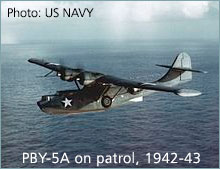
PBY Catalina – the amphibious plane after which Lake Catalina is named – were to have a long career.
Read more >>
 

The plane was developed by the US company Consolidated Aircraft in Buffalo, State of New York – the designers name was Isaac M. Laddon – and the plane was produced from 1936-45.  The plane was a refined version of Consolidated’s first generation-plane, a ’flying boat’.
PBY was a USA Military abbreviation for Patrol Bomber - the Y denoted Consolidated, the company, and Catalina is the name of an Island in the Pacific off of Los Angeles, California.

During WWII the Allied used PBY Catalinas to escort convoys, to track and fight German submarines and to transport cargo. The plane was also part of the military campain against Japan – where some Catalinas were painted pitch black not to be spotted during night operations; these planes were dubbed ’Black Cats’.

A total of 3.305 PBY Catalinas were built: 2.661 in USA, 620 in Canada and – officially - 24 in the USSR, which for some years had a license-agreement with Consolidated.

Following WWII a number of countries – Denmark included – bought Catalinas. Denmark acquired six planes i 1947. One of these planes later was later stationed in Greenland where it, among other assignments, was used in connection with a mapping project.

PBY Catalinas were slow flyers – they did not go much faster than 200 kilometer per hour – but they were notorious for their endurance and were able to travel more than 5.000 kilometer without having to refuel.
The plane could land on water as well as on land.

For a very long period after WWII PBY Catalinas were also used as so-called ’water bombers’ when figting forest fires.

Niels Bohr Institute
University of Copenhagen
Jagtvej 155 A, 2200 Copenhagen N.
Contact:
Henrik Larsen
henrik.larsen@sciencewriter.dk

University of Copenhagen

  • Management
  • Administration
  • Faculties
  • Departments
  • Research centres
  • Animal hospitals
  • School of Dentistry
  • Libraries
  • Museums and attractions

Contact

  • Map
  • Find an employee
  • Contact UCPH

Services

  • Press and media service
  • Merchandise
  • IT-support
  • For suppliers

For students and employees

  • KUnet

Job and career

  • Job portal
  • Jobs for students
  • Alumni

Emergencies

  • Emergency response

Web

  • Cookies and privacy policy
  • Accessibility statement
  • Information security

Connect with UCPH