
Antarctica:
17 February 2026
New knowledge about Northern Europe's radiator: Volcanic eruptions in the past may have pushed ocean currents towards collapse
Climate
New research from the University of Copenhagen suggests that volcanic eruptions during the Ice Age may have triggered sudden climate change by disrupting the Atlantic Meridional Overturning Circulation (AMOC), causing temperatures to fluctuate between hot and cold for thousands of years. The study contributes missing pieces to our understanding of what could cause Northern Europe's radiator to shut down.
If it goes down, Denmark's climate could change dramatically. The AMOC, Atlantic Meridional Overturning Circulation, pumps warm water from the southern hemisphere towards the north and is crucial to ensuring a warm and mild climate in Denmark. That is why it is also called Northern Europe's radiator. If it collapses, the Danish climate could change to something resembling that of Alaska, with winter temperatures down to minus 35 degrees.
However, global warming and the larger amounts of meltwater from the Arctic threaten the stability of the ocean current and its ability to pump warm water from the south to the north. However, scientists around the world continue to disagree on how bad the situation is, how great the risk of a complete collapse of the ocean current is, and how quickly it could happen.
In a new study conducted by an international team of researchers from, among others, the Niels Bohr Institute at the University of Copenhagen, the researchers are now adding another element to the pool of things that can cause the AMOC ocean current to change: volcanic eruptions.
“Our study shows that the AMOC may be far more sensitive to external influences, such as volcanic eruptions, than we previously thought. This provides important insight into how the system may also react in the future,” says Professor Markus Jochum from the Niels Bohr Institute, who is the last author of the study.
May explain sudden climate change
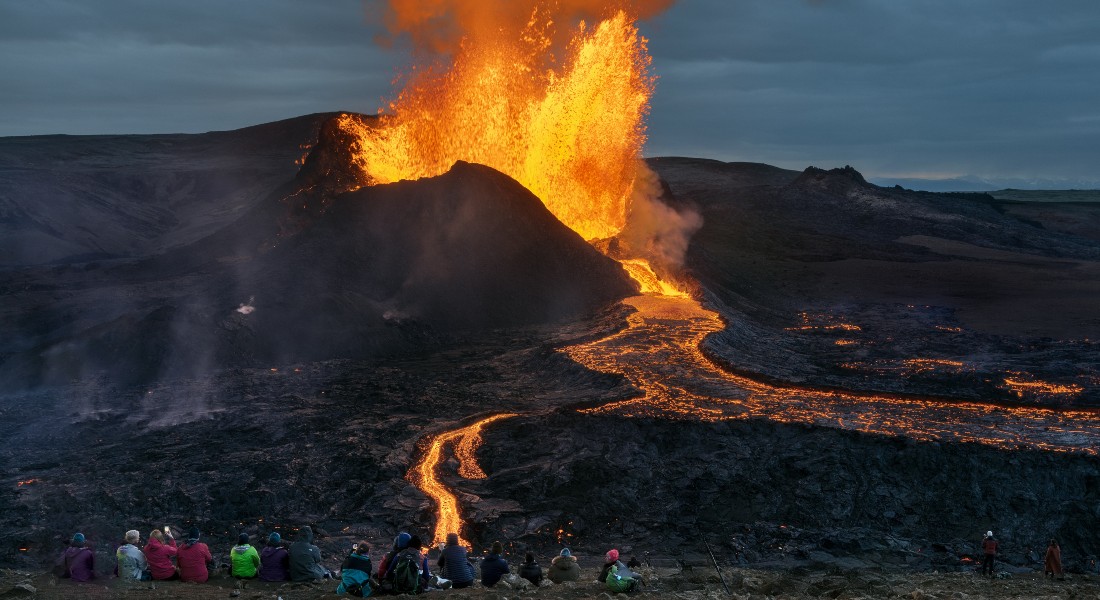
By combining data from ice cores with hundreds of climate models, the team of researchers has shown how extreme volcanic eruptions can throw the climate system out of balance and push the important AMOC ocean current into a weakened or completely collapsed state.
“We show that large volcanic eruptions near the equator have historically been able to cause a collapse in the Atlantic Ocean current, which in turn could trigger sudden climate changes that lasted for thousands of years,” says lead author Guido Vettoretti from the Niels Bohr Institute.
Large volcanic eruptions send sulphur and dust into the atmosphere and stratosphere, which prevents the sun from warming the Earth. This sets off a cold chain reaction that leads to, among other things, more sea ice and a change in the salinity of the ocean, which ultimately puts the ‘pump’ in the AMOC out of operation.
The last ice age ended over 10,000 years ago, but lasted for 100,000 years, during which there were repeated sudden shifts between cold and warm periods – the so-called Dansgaard-Oeschger events. These are climate events whose causes have long been debated by scientists.
Here, the new study shows that very large volcanic eruptions could be the very cause that significantly changes the climate for centuries or millennia – especially if the climate has already approached a critical point, as we are seeing in our age of global warming.
“It's like tilting a balance board – if the system is close to a tipping point, only a small push is needed. Our model shows that a volcanic eruption can be that push,” explains Professor Markus Jochum, who is the last author of the study.
More about the study
The researchers used the CCSM4 climate model to simulate the climate during ice age conditions. The model divides the atmosphere and ocean into fields of approximately 3° × 3° and describes the atmosphere in 26 layers up to a height of approximately 40 km. It has previously been used to simulate rapid climate change during ice ages.
The model reproduces the Atlantic Ocean circulation (AMOC), which transports heat northwards. In this low-resolution version, the water layers are slightly less deep than in the standard version. The researchers have changed how water mixes in the deep sea below 2500 m, because the precise tidal mixing during ice ages is unknown.
To test the model, the researchers compared six simulations with observations from the 20th century. The model realistically recreates the effects of greenhouse gases and volcanic eruptions, as well as the observed warming.
The research was conducted in collaboration with colleagues from Norway, Switzerland and Taiwan. The researchers behind the study are: Guido Vettoretti, Ruei-Jia Hu, Ingo Bethke, Kirstin Krüger, Michael Sigl, Stephen Outten, Jaimei Lin, Roman Nuterman, Anders Svensson, Peter Ditlevsen and Markus Jochum.
The study has been published in Science: https://www.science.org/doi/10.1126/sciadv.adx2124
Contact
Markus Jochum
Professor
Is-, Klima- og Geofysik
Niels Bohr Institutet
Københavns Universitet
mjochum@nbi.ku.dk
+4535326921
Michael Skov Jensen
Kommunikationskonsulent
Presse
Københavns Universitet
msje@adm.ku.dk
+4593565897