
Seminar by Professor Landry Bretheau, Ecole Polytechnique
Superconducting Quantum Devices with Carbon Nanotubes
ABSTRACT: The Josephson effect, which describes the coupling between two superconductors through a weak link, is the basis of several quantum devices.
While it was mainly harnessed in tunnel junctions, hybrid Josephson junctions – in which quantum conductors are used as weak links – offer a rich physics to explore. Among them, carbon nanotubes (CNT) are particularly promising owing to their one-dimensional nature.
These elementary quantum conductors combine structural simplicity with potential coherence enhancement. In this seminar, I will review a series of experiments performed on CNT-based Josephson junctions.
They are based on our ultraclean nanofabrication technique that exploits hexagonal boron nitride both as a pickup substrate and a pristine dielectric environment, which enables integration in superconducting circuits.
In a first experiment, we measured the supercurrent of a CNT Josephson junction via low-frequency quantum transport. The gate-dependence of the critical current exhibits sharp variations associated with quantum phase transitions of the fermionic Andreev ground state of different parities, owing to the interplay between superconducting pairing and Coulomb repulsion.
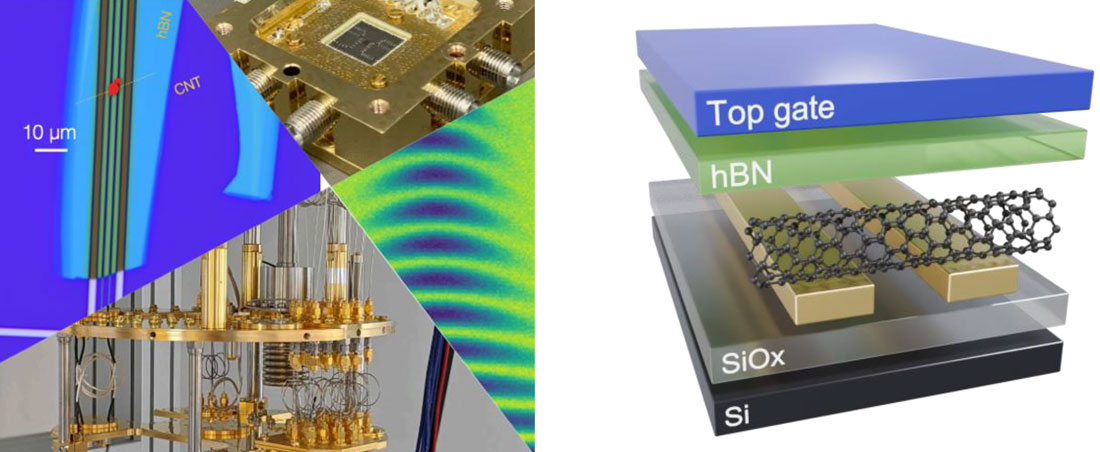
Going further, these measurements reveal a distinctive fourfold periodic modulation linked to the combined spin and orbital degeneracy of CNTs.
In a second experiment, we implemented a CNT-based superconducting qubit, which is integrated into a circuit quantum electrodynamics architecture. The measured qubit spectrum can be tuned with a gate voltage over more than 4GHz and reflects the underlying Andreev physics.
Going further, we demonstrate coherent control of this gatemon qubit through Rabi and Ramsey protocols, with T2* coherence times up to 200 ns, marking a significant milestone for carbon nanotube-based quantum devices. Finally, by probing the qubit spectra at higher frequency, we access the microscopic Andreev physics.
References:
[1] S. Annabi, E. Arrighi, A. Peugeot, H. Riechert, J. Griesmar, K. Watanabe, T. Taniguchi, L. Bretheau, and J.-D. Pillet, Phys. Rev. Applied 22, 064035 (2024). https://doi.org/10.1103/PhysRevApplied.22.064035
[2] H. Riechert, S. Annabi, A. Peugeot, H. Duprez, M. Hantute, K. Watanabe, T. Taniguchi, E. Arrighi, J. Griesmar, J.-D. Pillet, and L. Bretheau, Nature Communications, 16, 7197 (2025). https://www.nature.com/articles/s41467-025-62283-y
Bio:
Landry Bretheau is Professor at Ecole Polytechnique. He carried out his Ph.D. at the CEA Saclay and then conducted two successive post-docs at ENS (France) and MIT (USA).
- In 2017, he founded a new lab – the QCMX Lab – together with his colleague Jean-Damien Pillet, which explores the physics of Hybrid Quantum Circuits.
- To develop this new activity, Landry was awarded a Young Team Fellowship from Ecole Polytechnique, a Young Researcher Grant from the French National Research Agency and an ERC Starting Grant from the European Research Council.
- His work has led to major contributions in the fields of Mesoscopic Superconductivity and Quantum Circuits, with the publication of articles in the scientific journals Nature, Science, and Physical Review and was awarded the 2020 Nicholas Kurti Science Prize.