
Niels Bohr Lecture by Associate Professor Douglas Brumley
The role of fluid dynamics in biological active matter
ABSTRACT
Despite their minuscule size, microbes drive large scale processes such as carbon storage in the ocean, the health of plants, and energy production in industrial bioreactors. In all of these systems, ubiquitous fluid flows fundamentally alter the behaviour of microbes, transporting and concentrating them into preferred locations, mixing and redistributing food sources, and shaping chemical signals that organisms use for communication and navigation. A better understanding of these flows is integral to solving multidisciplinary global challenges, from resilience of corals to disease transmission.
In this talk, I will discuss the role that fluid flows play in shaping the ecology of microbes, from the level of individual cells through to coral reefs and the open ocean. In each case, I will demonstrate how iteratively combining video-microscopy, image processing and mathematical modelling can resolve features of microbial lifestyles that are difficult or impossible to see otherwise, and show how single-cell measurements can be connected to bulk processes at the population-level.
BIOGRAPHY
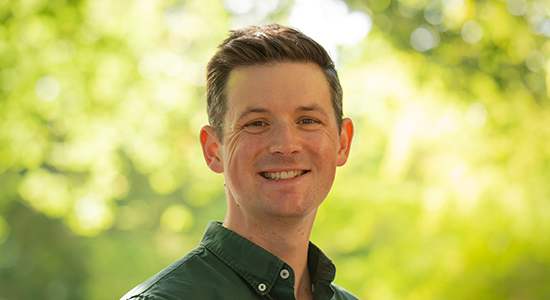
Douglas Brumley is an Associate Professor in Applied Mathematics at the University of Melbourne. His research group utilises mathematical modelling, lab-based experiments and field observations to address open questions in biology.
Douglas completed a PhD in Mathematics at the University of Cambridge (Gates Cambridge Scholarship), and Postdoctoral Fellowships at Massachusetts Institute of Technology, USA, and ETH Zürich, Switzerland, before moving to the University of Melbourne where he has formed an interdisciplinary research group at the interface of biology and mathematics.
Supported by research grants and Fellowships — for example from the Gordon and Betty Moore Foundation, Human Frontier Science Program and Australian Research Council — Douglas’ group uses quantitative microscopy and mathematical modelling to investigate fluid flows in biology, ranging from corals, plants, gut microbiota to the open ocean.