
Niels Bohr Lecture by Chihway Chang, University of Chicago
Mapping Cosmic Structure: Past 10 Years, Next 10 Years
ABSTRACT
A vast amount of information is stored in the large-scale structure of the Universe — dark matter is distributed differently depending on the history and composition of our Universe. Over the past 10 years, we have used galaxy surveys to make ever larger maps of the sky in order to measure this large-scale structure. By combining measurements of weak gravitational lensing and galaxy clustering, we infer the parameters that govern how the Universe evolves and potentially discover new physics beyond the standard cosmological model.
In this talk I will give an overview of the field of observational cosmology with galaxy imaging surveys. I will present results from the latest analyses of the Dark Energy Survey, and what we should expect from the next generation of surveys: the Euclid Mission, the Vera C. Rubin Observatory Legacy Survey of Space and Time, and the Roman Space Telescope.
BIOGRAPHY
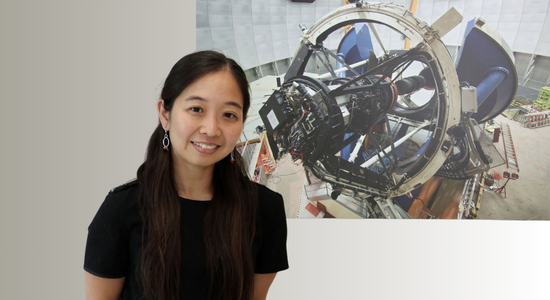
Chihway Chang is an Associate Professor of the Astronomy and Astrophysics (A&A) Department at the University of Chicago. She received a B. Sc. in Physics at the National Taiwan University (2007) and a PhD in Physics at Stanford University (2013). She went on to be a postdoctoral fellow at ETH Zurich (2013-2016), and then a KICP Fellow at the University of Chicago (2016-2018). She became an Assistant professor at the University of Chicago in 2018 and Associate in 2025. She received the DOE Early Career Award in 2021.
Chang is an observational cosmologist interested in answering fundamental questions in cosmology (the nature of dark matter and dark energy, early universe physics, etc.) using cosmic surveys, in particular galaxy and CMB surveys. Her group works on a wide range of survey topics, from the pixel level to cosmological inference. She is one of the Science Committee Co-Chairs of the Dark Energy Survey (DES) and has previously served as the Deputy Analysis Coordinator of the Rubin Observatory’s Legacy Survey of Space and Time Dark Energy Science Collaboration (DESC). Her group is also heavily involved in the Roman Space Telescope High Latitute Imaging Survey Project Infrastructure Team.