
Niels Bohr Lecture by Geoffrey West, Santa Fe Institute
Title: Emergent Laws of Life, Growth & Death from Organisms and Cities to the Future of the Planet
Abstract: Life is very likely the most complex phenomenon in the Universe, yet many of its characteristics obey surprisingly simple scaling laws: in the Biosphere, time-scales and rates such as metabolism, growth, lifespans and evolution, and sizes such as genome lengths, RNA densities and tree heights, systematically scale as power laws with exponents typically simple multiples of 1/4.
Likewise, in the Anthroposphere, wages, profits, patents, roads, pollution, crime and disease all scale in an approximately “universal” fashion manifested in cities and companies across the globe. These laws emerge from the underlying generic dynamical and geometric structure of optimized space-filling, fractal-like social, infrastructural, resource and information networks that sustain life across all scales.
They lead to a coarse-grained framework for quantitatively understanding many features of biological and social systems including why we stop growing by age 20, live for 100 years and sleep 8 hours a day, why cities persist whereas almost all companies die, and why the pace of life continues to accelerate.
Globally, the theory predicts the observed super-exponential growth of the Anthroposphere, driven by innovation and wealth creation, leading to a finite-time singularity. This signals a second-order phase transition potentially resulting in depopulation and collapse, thereby threatening the long-term sustainability of the planet.
About the speaker
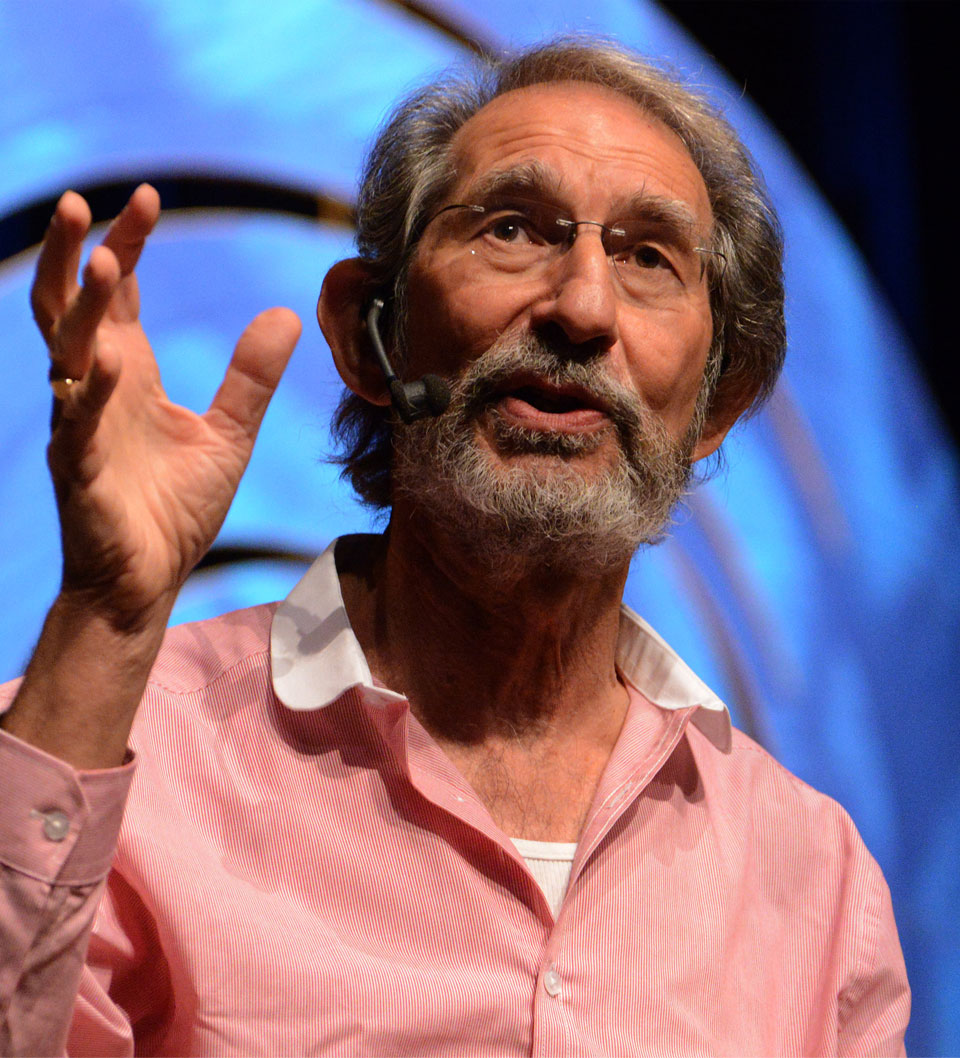
Geoffrey West is the Distinguished Shannon Professor and former President of the Santa Fe Institute, and a visiting professor at Imperial College, London. He is a theoretical physicist who previously held positions at Stanford and Los Alamos.
His primary interests have been in fundamental questions across the physical, biological and social sciences ranging from quarks and dark matter to cells and cities, and from growth and mortality to innovation and long-term global sustainability.
Most recently, he is best known for his work on scaling laws and as an originator of the Metabolic Theory of Ecology and of the Science of Cities.
West has lectured at many high profile events including TED and Davos and his work featured in many publications, podcasts and TV productions, including the Venice Biennale.
He authored the best-selling book Scale and was named to Time magazine's list of 100 most influential people in 2007.