
Niels Bohr Lecture by Monica Dunford
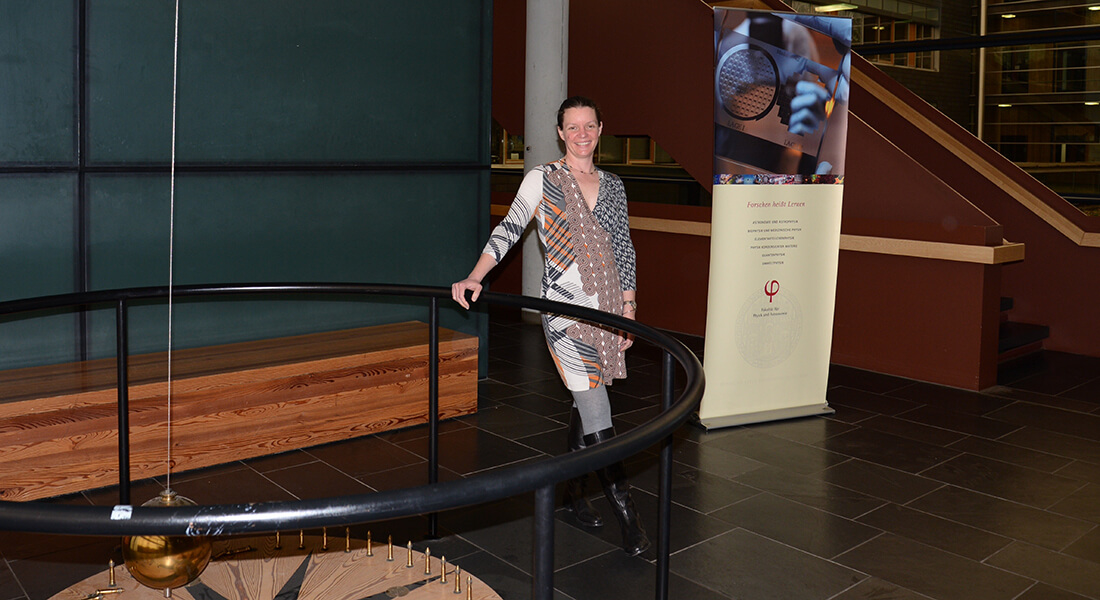
A Microscopic View of the Macroscopic: Mass, Matter, and New Possibilities at the LHC
Abstract: What determines the structure of our universe—from the smallest particles to the vast cosmic web? At the heart of this question lies the Standard Model of particle physics and one of its most remarkable discoveries: the Higgs boson. While it explains how fundamental particles acquire mass, it may also hold clues to some of the deepest mysteries in physics, including the nature of dark matter and the origin of the matter–antimatter imbalance in the universe.
In this lecture, Monica Dunford will explore how measurements once thought impossible are now becoming reality at the Large Hadron Collider. By combining cutting-edge detector technologies with powerful data science techniques, physicists are pushing the boundaries of what can be measured and discovered. The talk will highlight how precision studies and innovative search strategies are opening new windows onto fundamental physics—and how the next generation of technologies will take us even further in connecting the microscopic world to the evolution of the universe.
Bio: Monica Dunford is an experimental particle physicist at Heidelberg University and a prominent member of the ATLAS experiment at CERN’s Large Hadron Collider. Her research lies at the forefront of precision studies of the Standard Model, where she has made significant contributions to electroweak physics, quantum chromodynamics, and the understanding of the proton’s internal structure.
Beyond precision measurements, she is actively working in the search for new physics, including dark matter and novel phenomena accessible through innovative trigger-level techniques. Her work bridges fundamental physics and advanced technologies, with deep expertise in detector systems such as calorimetry and real-time trigger architectures.
Dunford has held key leadership positions within the ATLAS collaboration, including convenor of the Standard Model physics group and Physics Coordinator. She also led the electroweak working group for the recent update of the European Strategy for Particle Physics, focused on future collider programmes beyond the LHC. Beyond her scientific leadership, she is widely engaged in public outreach and science communication, and was featured in the award-winning documentary Particle Fever, which captured the discovery of the Higgs boson.