Climate Theory Group
MSc projects in Climate Theory.
Contact: Johannes Lohmann and Peter Ditlevsen
Physics-informed machine learning for non-linear complex systems

Machine learning (ML) is increasingly used in research, but dilemmata arise in situations where we cannot check whether the solution is correct. An example are long-term ML forecasts of complex systems used to replace computationally expensive physics-based models. A particular danger here is that non-linear complex systems can display coexisting dynamical regimes (stable steady states), while the training data may be restricted to only one or a subset of regimes. This is, for example, likely the case in weather and climate prediction models. Here the data is limited to the past century but physical considerations point to the existence of alternative dynamical regimes that may be reached in the future at climate “tipping points”.
Classical ML models are very good at emulating complex dynamics on a finite time horizon, but it is well-known that they can display seemingly plausible, but unphysical solutions, or diverge to infinity or to spurious alternative attractors. It is thus unsafe to trust ML forecasts in this context, without targeted efforts to teach a ML model all physically possible dynamical regimes despite the limited training data. In this project it shall be explored whether this is possible by finding efficient ways to explicitly or implicitly incorporate physics into the ML architecture, building on successful time series prediction models such as reservoir computers. This exploration can be done both on a conceptual level with simple non-linear ODE or PDE models, or on a complex applied problem involving data from climate model simulations.
Multistable fluid dynamics: laboratory analogue of a collapsing ocean circulation
 Research on multistability and tipping points in natural systems is performed from many angles, including basic mathematical research, development and simulation of process-based models, as well as reconstruction and data analysis of past regime shifts. But controlled laboratory experiments are rarely performed, and would nevertheless provide important alternative insights into the still poorly understood notion of tipping points in high-dimensional, heterogeneous real-world complex systems. We are building a laboratory analogue of the Atlantic Meridional Overturning Circulation (AMOC) in order to test a variety of key assumptions and predictions of tipping point theory in a physical system. A MSc student can perform their thesis by characterizing, exploring, and improving the prototype ocean setup in progress, and by performing measurements (such as particle image velocimetry) to investigate individual aspects of the overall agenda. These aspects include the existence of critical slowing down before the collapse and its relation to turbulent fluctuations, observables and fingerprints as early-warning signals, higher-order multistability when introducing heterogeneity, as well as rate-induced and non-equilibrium transitions.
Multistability in marine ecosystems
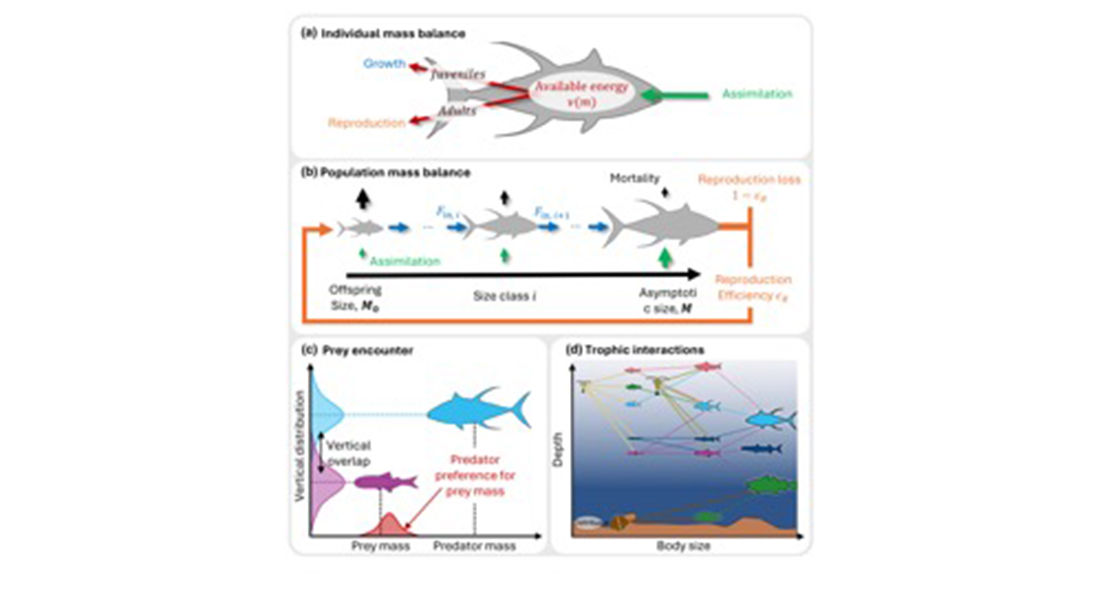 Ongoing changes in the climate system put stress on other complex systems in nature and society. An example are marine ecosystems, which comprise a complicated, spatially heterogeneous web of interacting species on many trophic levels from plankton to large fish and whales. The functioning and stability of these systems is in turn crucial for fishery and the societies that depend on it.
Whereas non-linear, irreversible changes to alternative states in the climate system are increasingly well-studied, the possibility for multiple stable states and regime shifts in realistic models of (marine) ecosystems has not been established. This project consists of a numerical exploration of a complex, spatially extended model of the marine ecosystem, which has been created by marine biologists and can be run and adapted from open-source packages. Using the large toolset of dynamical systems theory (e.g. Lyapunov exponents, rare event algorithms, reduction to collective variables) the rich dynamics will be analyzed and it will be tested if and under what conditions (model parameters and boundary conditions) the system can exhibit multistability.
Non-equilibrium systems: Large deviations, response operators and critical transitions
 The study of out-of-equilibrium systems is an important frontier in modern classical physics. Interesting applications and extensions of the concept arise in climate science and other complex systems with time-varying forcing. A range of conceptual models can be studied analytically and numerically to understand how different types of non-equilibrium determine how we should think about the functioning, predictability and stability of complex systems. Here is a non-exhaustive list of possible subjects:
- Thermodynamic non-equilibrium means that the system becomes a non-reversible stochastic process, with different relaxation versus fluctuation dynamics. A question here is how to best use the system’s stochastic fluctuations to infer about its (changing) stability. This can be studied in terms of Fokker-Planck operators or Green’s functions, and a particular interest is how these can be reconstructed from partial observations.
- Rare trajectories can lead to alternative metastable states, which are concentrated around a certain most likely path (instanton). It needs to be better understood how this path (as well as its duration and probability) depends on the strength of non-gradient forces and noise, as well as its correlation structure.
- Apart from thermodynamic non-equilibrium, there are further kinds of non-equilibrium related to relaxation towards a non-equilibrium steady state after perturbations, as well as time-dependent generalizations thereof called pullback attractors. This leads to variants of critical transitions that are not bifurcations in the quasi-stationary system. A goal here is to advance the operator-theoretic approach for this scenario, in order to find methods to predict such transitions. Further new types of indicators for non-equilibrium transitions might be explored from the vantage point of stochastic thermodynamics.
- Under chaotic dynamics, the boundaries of competing metastable states become fractal, which has consequences for the predictability under time-varying forcing. Using different paradigmatic dynamical systems it shall be tested numerically whether and how the overall predictability of the system (assessed by the probability of state transitions in small regions of initial conditions) is related to the fractal dimension of attractors and boundary, as well as to the initial distance from a (potentially time-varying) attractor.
Student Projects