
Quantum Quenches from Quantum Fields
In the Villum Investigator group we work at the interface between theoretical high energy physics, condensed matter physics and quantum information theory. We combine the language of quantum information theory with exact methods from theoretical high energy physics and study how quantum many body systems behave under sudden disturbances.
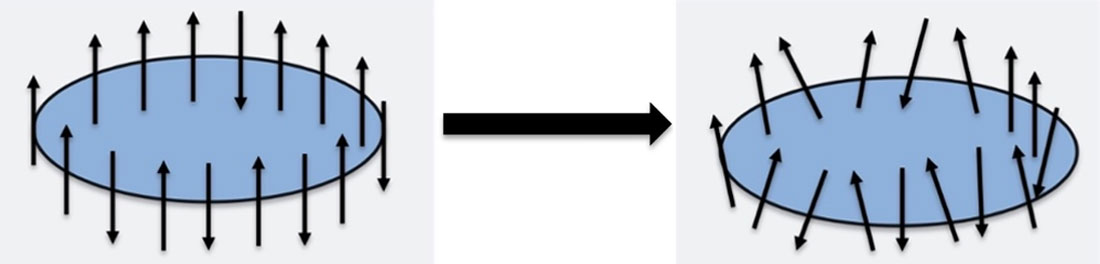
Professor Charlotte Fløe Kristjansen, former the Deputy Head of Institute for Research at Niels Bohr Institute (NBI) has been awarded a Villum Investigator grant of 20Mkr from the Villum Foundation to explore how quantum systems react to sudden disturbances with a research program entitled Quantum Quenches from Quantum Fields.
With earlier support form a DFF Sapere Aude Top Researcher grant Charlotte Fløe Kristjansen has built a research group which works at the interface of theoretical high energy physics, condensed matter physics and quantum information theory.
The Villum Investigator research program will start in the Fall of 2025 and run for six years.
What happens when a quantum system is exposed to a sudden disturbance, known as a quantum quench?
This question is of topical interest for the entire quantum community from condensed matter experimentalists working with cold atoms to theorists operating in the realm of quantum information theory.
The present project will apply methods from theoretical high energy physics to answer questions about the post-quench behavior of specific quantum systems outside the traditional realm of condensed matter physics.
In quantum mechanics one has a duality between particles and waves which constitutes a cornerstone of the theory. In the same way, one of the pillars of modern theoretical high energy physics also takes the form of a duality, namely a duality between quantum field theory and string theory, known as the Maldacena duality.
In quantum field theory one describes the smallest constituents of matter as particles whereas in string theory one describes these as one-dimensional objects known as strings.
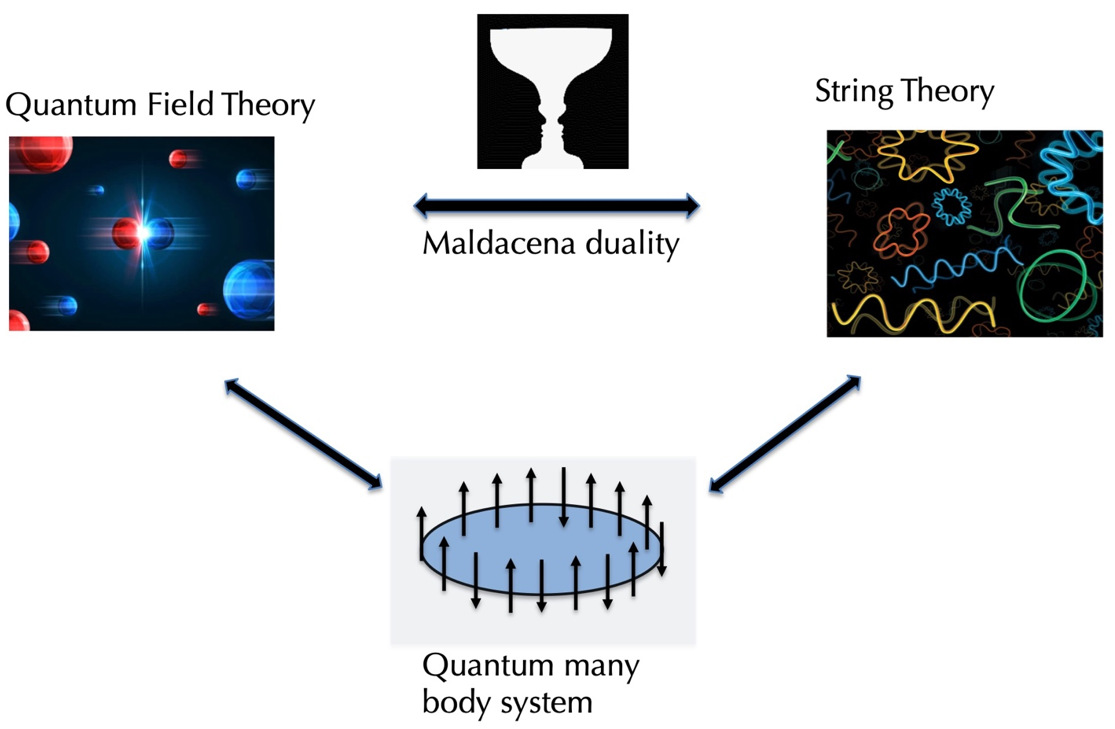
The duality between particles and strings also implies that the preferred states and energy levels of the two theories can be identified with the states and energy levels of a much simpler system, a so-called spin chain which is exactly a quantum many body system of the type that one can use to model the systems of cold atoms that one uses for quantum quench experiments.
Quantum field theory and quantum many body systems
In the Villum Investigator group we work mainly on the connection between quantum field theory and quantum many body systems. On the quantum field theory side we are interested in considering systems with defects or boundaries.
Defects and boundaries are ubiquitous in physics since realistic physical systems are not perfect and they typically have boundaries.
We are particularly interested in defects which arise as a consequence of the field theory in question having a non-trivial vacuum. A famous example of a quantum field theory with a non-trivial vacuum is the Standard Model of Particle Physics where the Higgs particle arises precisely as a consequence of the non-trivial vacuum.
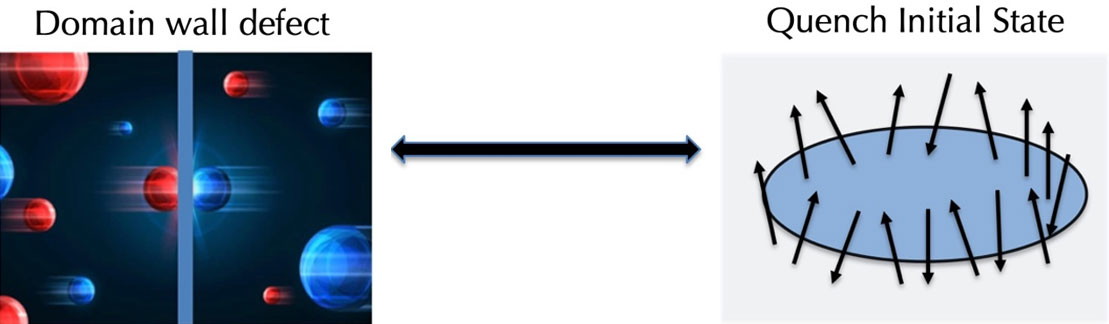
An example of a defect of the above type could be a domain wall which separates two regions of space where the quantum field theory is in different vacua. This is illustrated in the left hand side of the picture below.
It turns out that considering such a defect in the quantum field theory entering the Maldacena duality corresponds to performing a quench (a disturbance) of the underlying quantum many body system (spin chain) as illustrated in the right hand side of the figure below.
 In the Villum investigator group we work on developing exact methods to describe the behavior of the quantum many body system after a quench.
Furthermore, we are working on giving a quench description of specific defects which play a central role in theoretical high energy physics. Examples are one-dimensional defects known as Wilson and ‘t Hooft lines, the behavior of which can signal phase transitions in a quantum field theory.
A famous example of such a phase transition is the transition where quarks, which are normally trapped inside hadrons, become free particles. Giving a precise description of this transition constitutes one of the seven millennium problems posed by the Clay Mathematical Institute.
Most recently we have initiated a description of black holes in the spin chain language. In our description of quench dynamics we make use of concepts from quantum information theory.
Kristjansen and Z. Zarembo, Black holes in Quantum Spin Chains, arxiv:2512.23432 (hep-th), https://arxiv.org/abs/2512.23432
Kristjansen and K. Zarembo, ’t Hooft loops in N=4 super Yang-Mills, JHEP 02 (2025) 207, arxiv: 2412.01972 (hep-th), https://arxiv.org/pdf/2412.01972
Chalabi, C. Kristjansen and Chenliang Su, Integrable corners in the space of Gukov-Witten surface defects, Phys. Lett. B 866 (2025) 139512, arxiv:2503.22598 (hep-th), https://arxiv.org/pdf/2503.22598
 Charlotte Fløe Kristjansen, Professor,
Phone: +45 353-25381
Email: kristjan@nbi.dk
Staff
| Name | Title | Phone | |
|---|---|---|---|
| Search in Name | Search in Title | Search in Phone | |
| Kristjansen, Charlotte Fløe | Professor | +4535325381 | |
| Shusharin, Andrey | PhD Fellow | +4535326759 | |
| Su, Chenliang | Enrolled PhD Student | ||
| Zarembo, Konstantin | Professor |
External staff & students
| Navn | Titel | Telefon | |
|---|---|---|---|
| Franciszek Nawrocki | MSc student | ||
| August Kiersgaard | BSc student |