
Astrophysics
2 March 2026
A Night at Brorfelde Observatory
Interview with Politiken’s science editor:
Assistant professor Sarah Pearson (DARK, NBI) recently visited Brorfelde Observatory with Politiken’s science editor Lasse Foghsgaard.
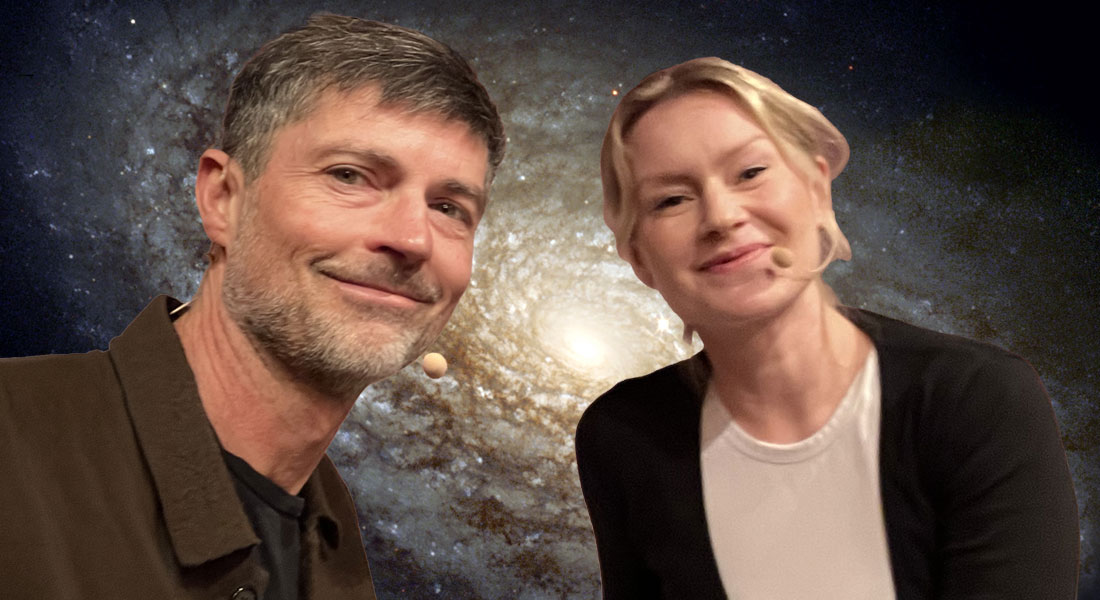
Through Denmark's largest telescope they observed the Andromeda Galaxy, the same galaxy Vera Rubin used in the 1970s to measure stellar rotation curves and build the case for dark matter as the invisible mass holding galaxies together.
The secret of the dark matter
Dark matter makes up around 85% of all matter in the universe. Its only confirmed interaction with ordinary matter is gravitational, and these effects show up in several ways: galaxies rotate far too fast to be held together by their visible mass alone, light bends more than expected around massive objects, and colliding galaxy clusters like the Bullet Cluster show mass distributed differently from the visible matter.

We can also see dark matter’s imprint in the cosmic microwave background. We know dark matter is there. We just do not know what it is, making it one of the biggest open questions in modern physics.
Physicists are searching for dark matter through three main approaches: by looking for missing energy in particle collisions at accelerators, by attempting to detect interactions in large Xenon tanks deep underground, and by searching for gamma rays or other particles produced if dark matter annihilates or decays. So far none of these methods has found a confirmed signal.
Live interview with audience
Sarah Pearson studies stellar streams, the long trails of stars left behind when smaller galaxies or globular clusters are pulled apart by the gravity of larger ones.
As these streams orbit a galaxy, stars leak out into long, thin stellar streams and clumps of dark matter can punch gaps and distortions into these streams. By mapping these imprints, Sarah's research group at the Niels Bohr Institute aims to constrain how dark matter is distributed and what properties it might have, work that could help point particle physicists toward what they should be looking for.
Lasse Foghsgaard's interview with Sarah about her dark matter research and stellar streams is published in the Sunday PS section of Politiken on 1 March 2026. They also appeared live at the Politiken Festival on Saturday 21 February, discussing their trip to the observatory and Sarah's research in front of a live audience.
Contact
Sarah Pearson, Assistant Professor
E-mail: sarah.pearson@nbi.ku.dk
Telephone: +45 35 32 38 70