
ERC Synergy Grant:
4 December 2025
NBI Scientists Contribute to New Eske Kath Artwork for Grønningen 2025 Exhibition
Grønningen 2025 Exhibition:
This week, two researchers from the Niels Bohr Institute, Assistant Professor Sarah Pearson and affiliated Associate Professor Jácome (Jay) Armas, participated in an inspiring collaboration between art and science.
Danish artist Eske Kath, known for integrating scientific perspectives into his visual language, invited five scientists from different disciplines to help initiate his newest large-scale work for the upcoming Grønningen 2025 exhibition at Den Frie Udstillingsbygning.
When the scientists from biology, astrophysics, quantum physics, chemistry, and economics joined Kath, they put on white lab coats, which stood in contrast to Kath’s paint-stained coat. From that moment on, the group worked largely in silence.
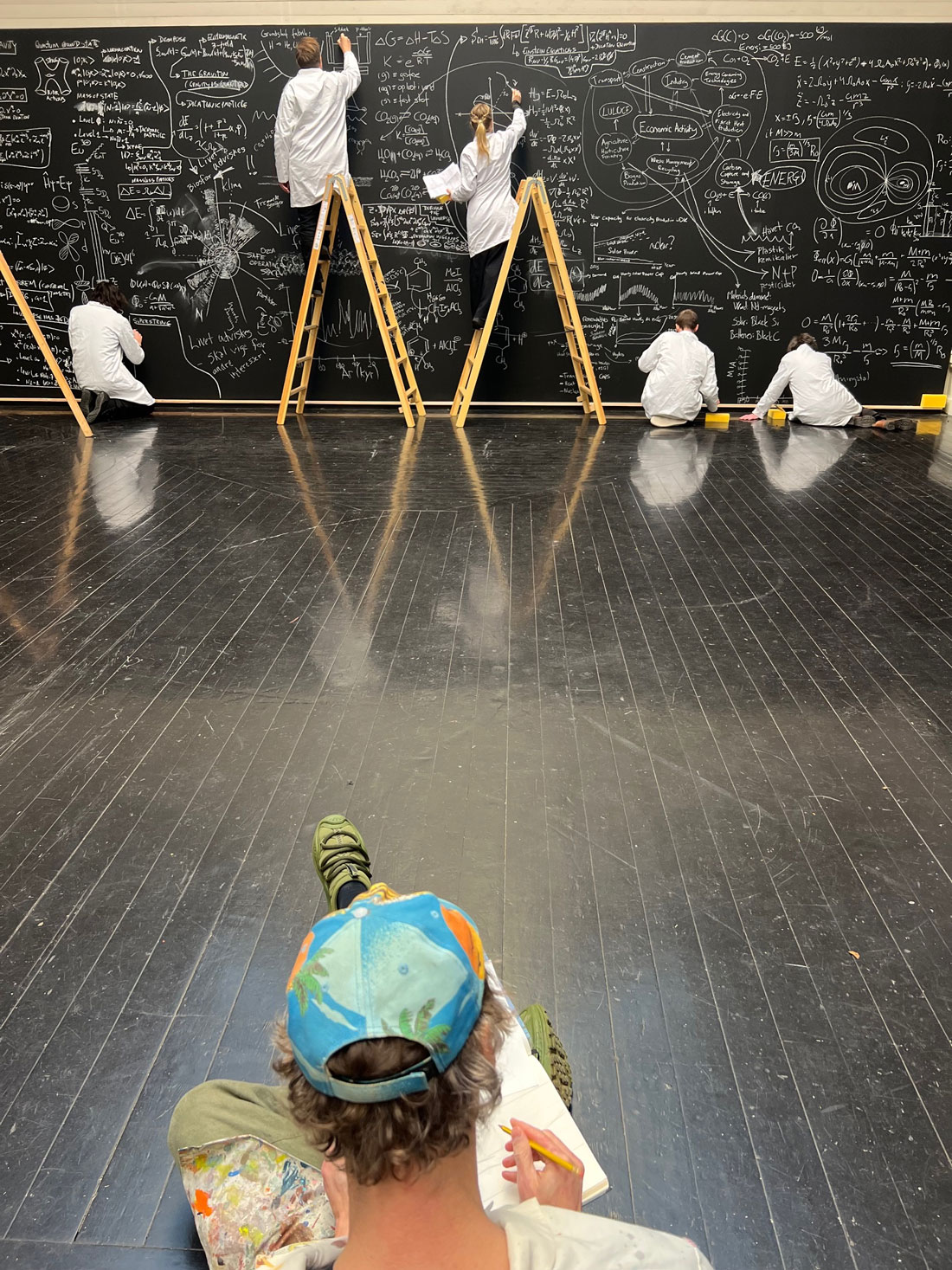
Kath asked each participant to “think about what you would like to convey from your scientific discipline—something fundamental to your field.” Their task was not to lecture, but to express concepts visually and mathematically, using chalk diagrams, symbols, and equations.
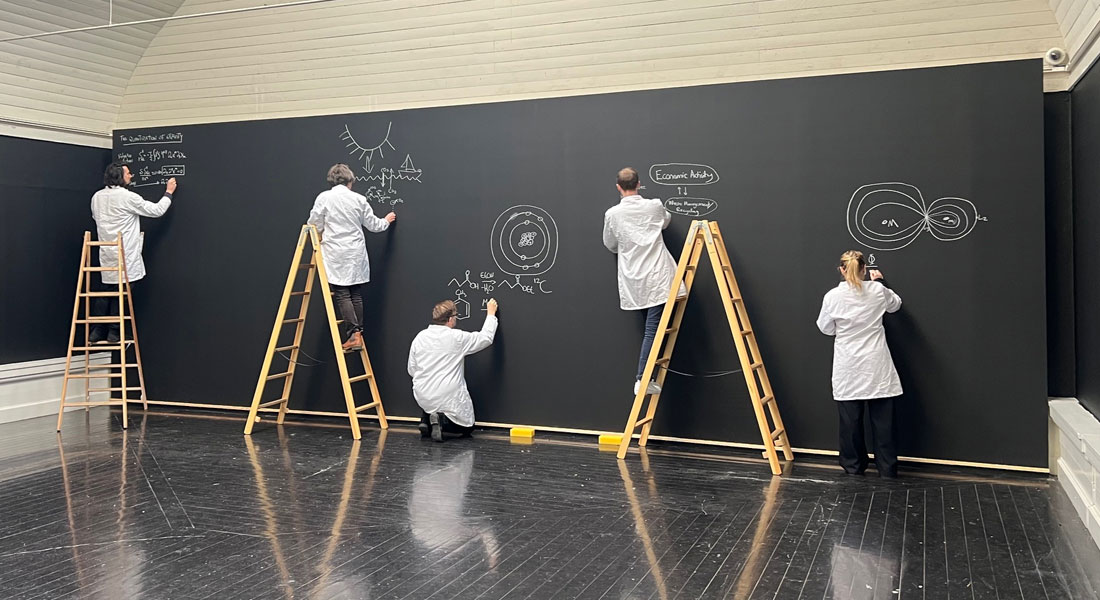
Ignoring one another just enough to preserve spontaneity, yet inevitably intersecting in space and structure, the scientists drew, derived, erased, and redrew across the giant chalkboard.
Smudges overlapped equations; diagrams merged and vanished; ladders were used to reach the upper edges of the wall.
Eske describes these interwoven marks as “fragments of a scientific investigation, traces of competing ideas, partial discussions, and overlapping perspectives.”
From NBI, Sarah Pearson and Jay Armas brought two different but foundational ideas from their research areas:
- Sarah Pearson, astrophysicist, derived the tidal radius from the restricted three-body problem, illustrating how stars can escape their host system and begin orbiting another galaxy—a core concept in her research on stellar streams and the dynamical history of galaxies.
- Jay Armas, theoretical physicist, derived equations related to the quantization of gravity within the framework of string theory, expressing how general relativity can be unified with quantum theory.
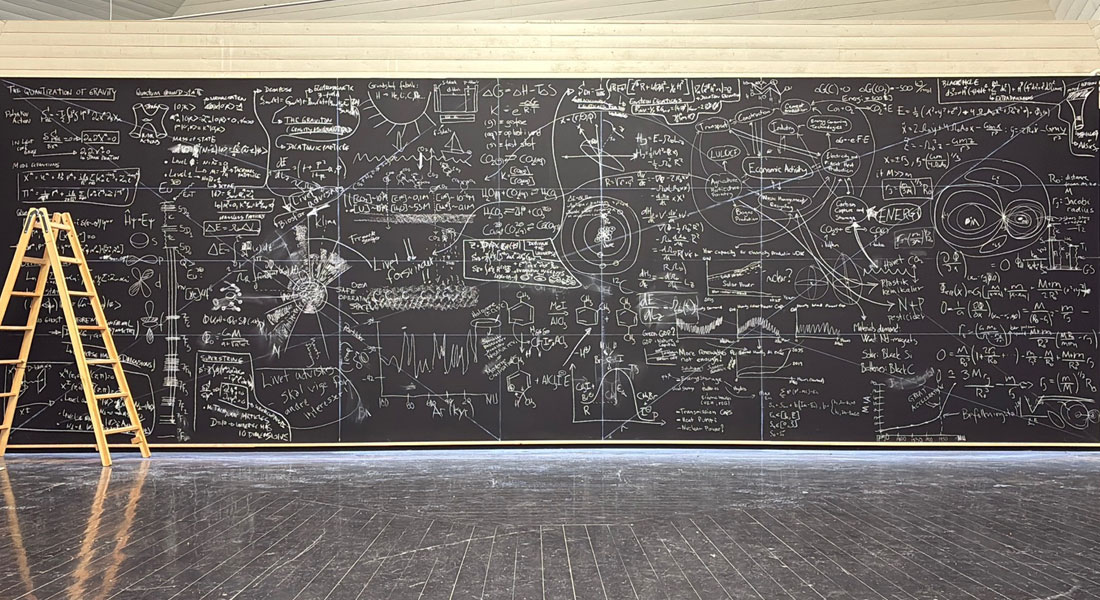
After roughly an hour of scientific mark-making, the researchers stepped back. Their contributions—dense, scattered, layered, and partly erased—became the ground upon which Kath would build his final painting. Kath marked out a set of underlying compositional guidelines.
These lines would later act as the structural foundation for the final artwork.
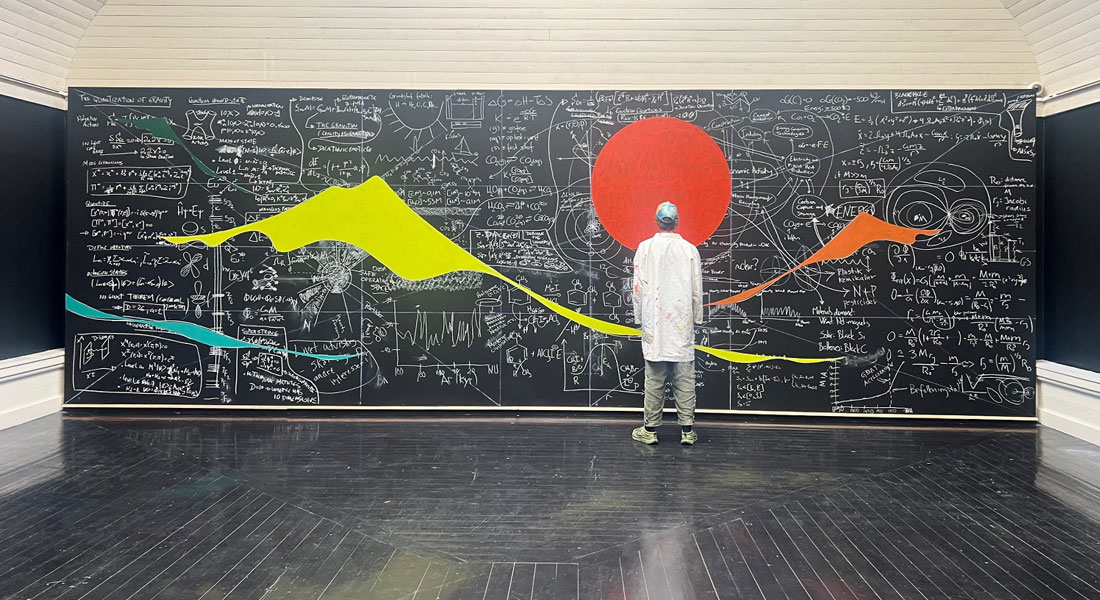
Throughout the rest of the day, he worked directly on this temporary layer of scientific notes, expanding the chalkboard fragments into an abstract landscape, letting the scientists’ traces remain visible as the textured substrate of the piece.
For Kath, the work is both a celebration of science and a commentary on its precarious role in public discourse. In his own words, the piece reflects his long-standing fascination with science, climate, and humanity’s fraught relationship with nature—but also critiques the “growing disregard for scientific knowledge” seen globally, including skepticism toward well-established findings such as climate research.
Integrating genuine scientific processes into his artwork becomes a way of making that tension visible.
- https://denfrie.dk/da/exhibition/groenningen-2025/
- https://eskekath.com/
- https://jacomearmas.org/
- http://drsarahpearson.com/
The completed piece will be on display at Grønningen 2025 – Den Frie Udstillingsbygning from December 6th, 2025 to January 24th, 2026. Visitors will be able to see how the dynamics of scientific reasoning have become embedded within the layers of Kath’s final mural.
Contact
Sarah Pearson, Assistant Professor
E-mail: sarah.pearson@nbi.ku.dk
Telephone: +45 35 32 38 70