
Quantum Photonics
Our quest is to develop a deterministic photon-emitter interface based using quantum emitters and photonic nanostructures for real-world quantum technology applications within quantum communication towards the Quantum Internet.
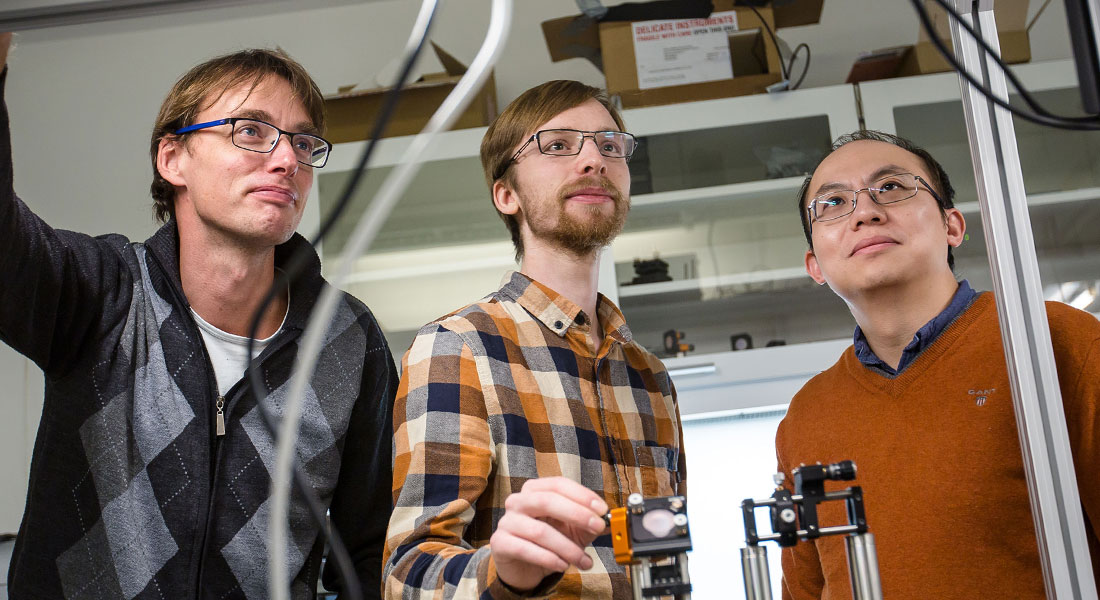
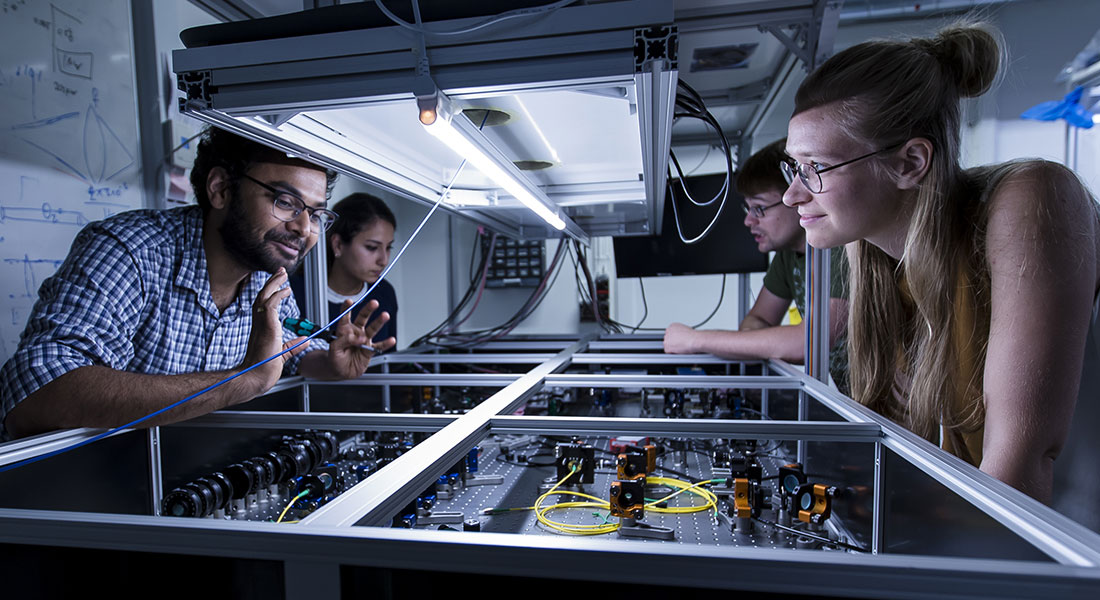
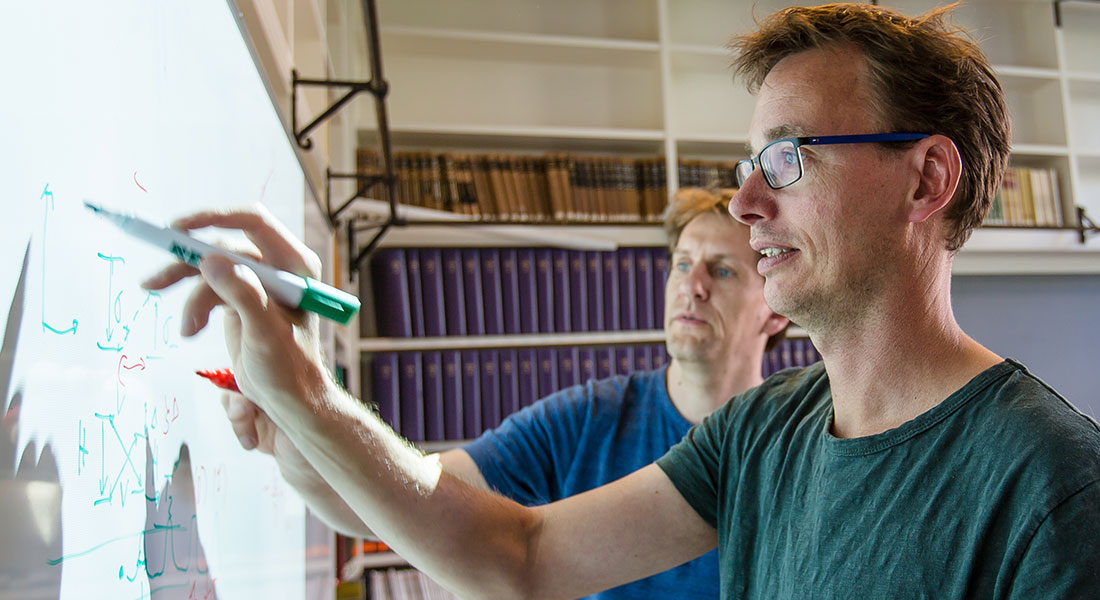
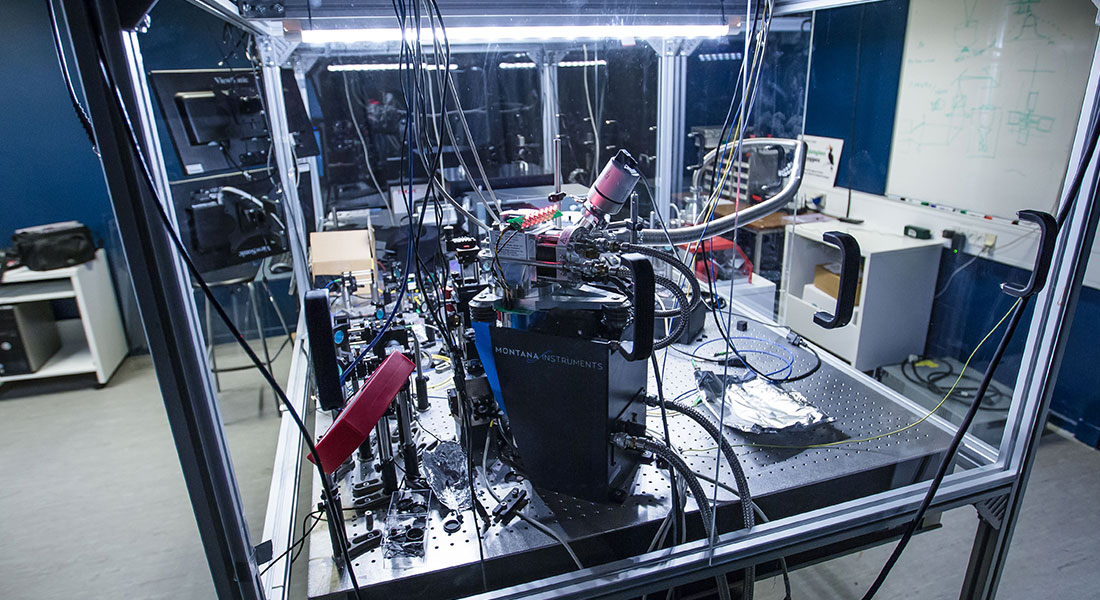
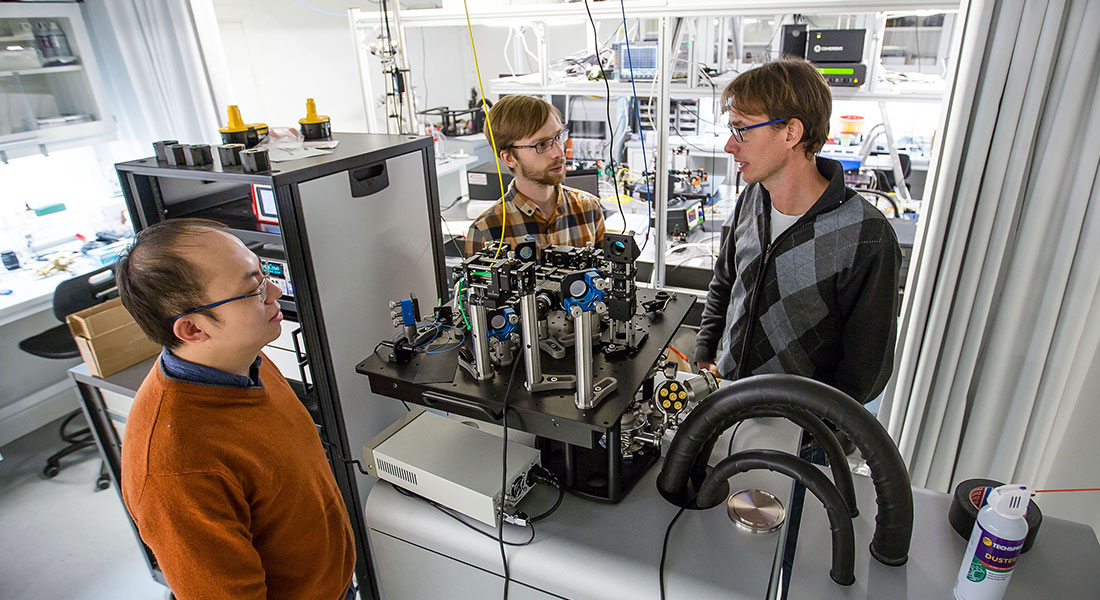
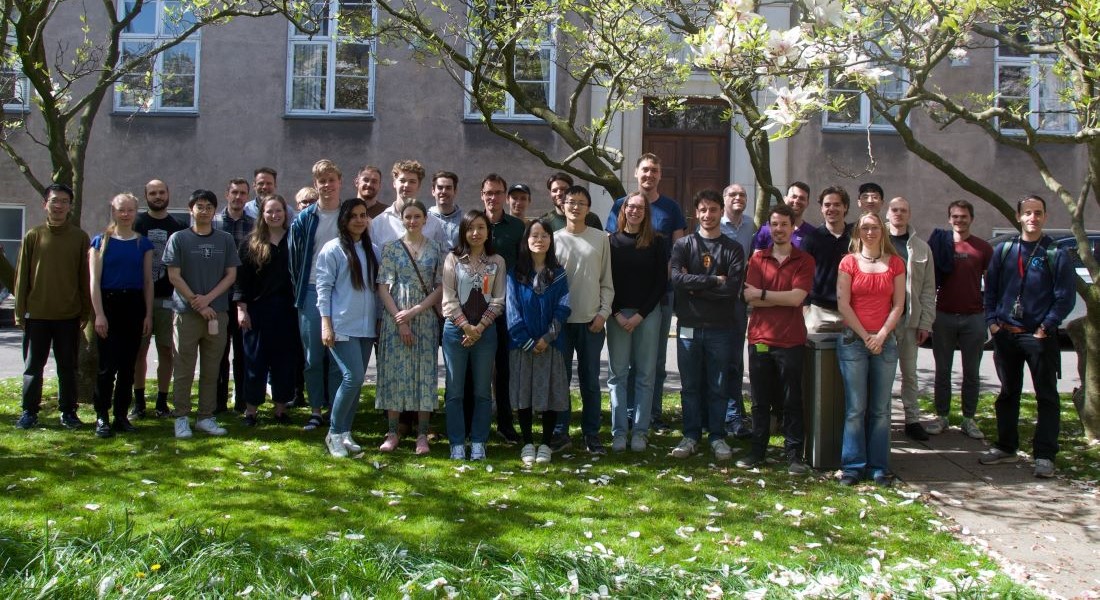
In nano-sized optical devices, light-matter interactions can be made so strong that quantum mechanical effects are decisive. The main focus of the Quantum Photonics Group is on techniques to control the quantum dynamics of quantum dots interacting with photons.
In this way we can fabricate light sources that emit single photons on demand, or entangle quantum dots and photons. Such nanophotonic devices will find applications for quantum information purposes and provide a route towards scalable quantum computing. In addition to developing and testing novel devices, we explore the fascinating fundamental physics of light and matter confined to the nano-scale.
Solid-state quantum simulators for biochemistry (SolidQ)
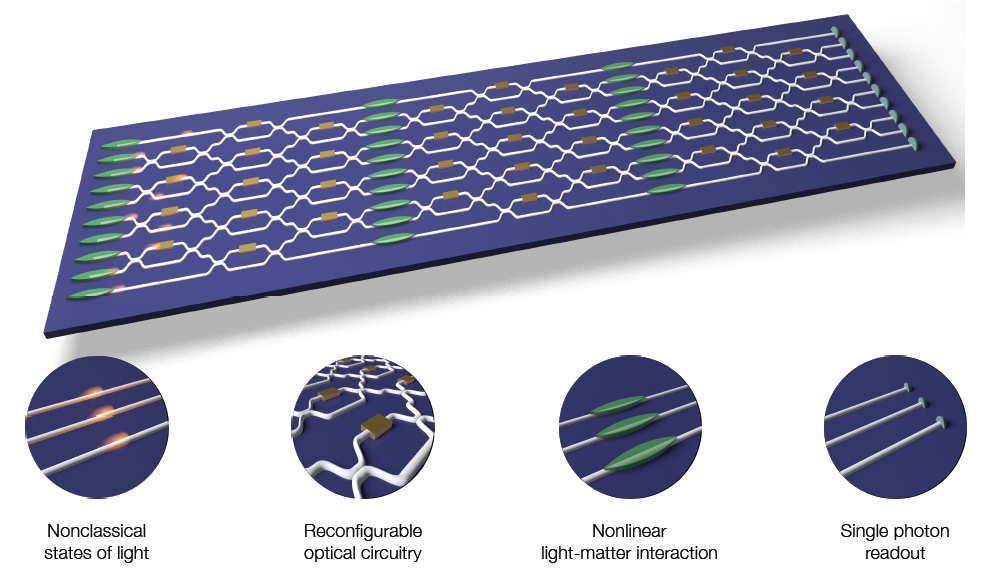 Solid-Q is a new joint research consortium generously funded by the Novo Nordisk Foundation that the Quantum Photonics group is proud to be a part of. Solid-Q unites two leading solid-state experimental platforms and applies them to problems in quantum chemistry and material science. An overarching goal is to characterize and eventually control charge, energy, and heat transport of relevance for molecular reactions, material design, and quantum coherent transport in light harvesting complexes. Ultimately our goal is to simulate protein folding problems of relevance for drug discovery with a quantum advantage.
Scalable quantum photonic devices
 Quantum photonics relies on the efficient and controlled generation of single photons for processing and exchanging quantum information across different nodes in a solid-state or hybrid quantum network. One of the main advantages of a solid-state platform is the possibility to integrate emitters such as semiconductor quantum dots (QDs) with nanophotonic circuits in a single chip, to build scalable quantum information processing devices. A challenging task in this direction is to scale photonic devices to perform experiments involving several quantum bits (or qubits).
Read more about Scalable quantum photonic devices
Quantum information processes with coherent single-photon sources
 Quantum physics enables communication and computation protocols that promise superior performance and security in comparison to the widely used classical methods. This promise has led to a widespread interest and a rapid surge towards realizing quantum technologies. Among the variety of physical systems that are being explored, Quantum Photonics is a natural choice for communication due to the ease and robustness of encoding information onto photons. Working at this exciting juncture of time on state-of-art single photon sources, we are currently delving into device-independent quantum cryptography protocols for secure communication including random number generation (QRNG) and quantum key distribution (QKD).
Read more about Quantum information processes
Nanofabrication
 Controlling and manipulating single photons at the chip scale requires state-of-the-art nano-fabrication techniques. The Quantum Photonics group has developed over the past years advanced processing methods for building nanostructures in gallium arsenide (GaAs) with tailored optical properties. These include passive devices such as waveguides, photonic crystals, and gratings, but also active electro-optic structures.
Read more about Nanofabrication
Controlling quantum light-matter interaction in photonic nanostructures
It is well known that the spontaneous emission of a quantum emitter depends not only on the intrinsic properties of the emitter, but also on the density of vacuum fluctuations surrounding the emitter.
Read more about quantum light-matter interaction
Multiphoton entanglement using quantum dot spins
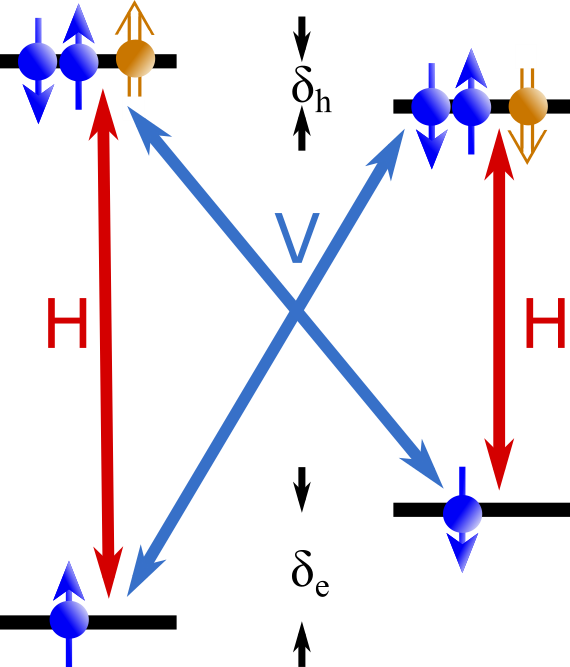 The ability to send quantum information over long distances would allow a number of quantum technologies such as Quantum Key Distribution for secure commination. However, sending information encoded as photons quickly becomes insurmountable over long distances due to photon loss. A possible solution to this problem is the One Way Quantum Repeater: Rather than sending a single photon the entire distance, a so-called cluster state consisting of multiple entangle photons is sent through a chain of repeater stations. At each repeater station the quantum information is transferred onto a “fresh” cluster state, and the gradual photon loss is thus overcome
Read more about Multiphoton entanglement
Quantum nonlinear optics
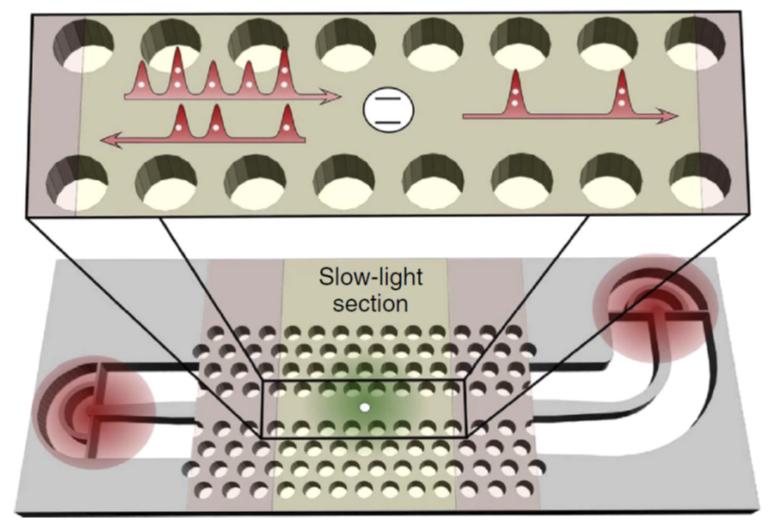 Photons usually interact very weakly with each other. This makes photons very well suited as carriers of quantum information in quantum communication. However, for many advanced quantum applications two-qubit gates are required, which requires nonlinear photon-photon interaction. An efficiently coupled quantum dot (QD) to a nanophotonic cavity or waveguide can mediate such a single-photon nonlinear operation since the QD can only scatter a single photon at a time, meaning that it responds very differently to one or two photons.
Experimental research in nanophotonics and quantum optics is tremendously costly. A thorough effort requires a certain critical mass both in terms of state-of-the-art equipment and man-power.
We gratefully acknowledge financial support from the following sources:
Deterministic generation of entangled photons
Device-independent cryptography achieves unbreakable security by exploiting quantum correlations (e.g. entanglement) between the sender and the receiver. The practical implementation of such protocols requires efficient and high-fidelity entangled photon sources. Solid state emitters are the way forward for efficient quantum light generation due to the possibility to integrate them into a nanophotonic structure. Recent demonstrations of high-fidelity (> 97%) polarization entanglement using the biexciton cascade in GaAs/AlGaAs quantum dots open exciting route for deterministic entanglement generation. The project will deal with several aspects of the nanophotonic interfacing of these quantum dots including: 1) Efficient preparation of the quantum dot, 2) Extraction of entangled photon pairs and state tomography, 3) Sources of noise limiting the entanglement fidelity, 4) near-future applications of the entangled photons for cryptography. For more information, contact Prof. Peter Lodahl (lodahl@nbi.ku.dk).
Coherent single photons: Interfacing with memories
The distribution of quantum states across nodes in a quantum network is the key requirement for secure communication and distributed computing. A typical quantum network will involve interfacing disparate qubits (matter, photon, spin, etc.) to ensure maximum efficiency. Photons are robust carriers of information and hence are critical for interconnection. The disparity between the frequency and bandwidth across the qubits pose challenges in the interconnection. Efficiently crafting the bandwidth of the photon is the key enabler for photonic interconnects. Quantum dot single photon sources typically generate photons with GHz bandwidth. Efficient interfacing of photons with quantum memories (holding time ~ 0.1 – 1 us) requires ~10 MHz bandwidth. A promising way forward to achieve such coherent single photons is through Raman processes in a Λ system. The project will deal with coherent photon generation using one of the Λ-systems of a trion in a InAs quantum dot. Key aspects: 1) Branching ratio and limits on the bandwidth of photons, 2) Generation and characterization 3) Pulse shaping for bandwidth manipulation. For more information, contact Prof. Peter Lodahl (lodahl@nbi.ku.dk).
Nonlinear chiral quantum optics
Chiral quantum light-matter interactions are a recently discovered consequence of using nanophotonic platforms for quantum optical experiments. In chiral scenarios, the light-matter interaction is strongly directional, meaning that the interaction of photons with a quantum dot strongly depends on which way they travel, allowing for the design of novel and non-reciprocal quantum devices. Within this project, we will explore the nonlinearity of such chiral quantum interactions, using a blend of numerical modelling and optical experiments. For more information, contact Prof. Peter Lodahl (lodahl@nbi.ku.dk).
Giant cooperativity in planar structures
Cooperativity is a fundamental property within quantum optics that captures the strength of the coupling between light (photons) and matter (quantum emitters). Within this project, we wish to enhance this cooperativity using resonant, planar nanophotonic structures, thereby setting the stage for the creation of efficient and complex quantum architecture. For more information, contact Prof. Peter Lodahl (lodahl@nbi.ku.dk).
Multicolour quantum optics
Quantum emitters such as quantum dots are inherently nonlinear at the ultimate, low-energy limit; after all, they can only absorb a single photon at a time. This inherently large nonlinearity means that the interaction of a single emitter with a single photon can be significantly tuned by a single, control photon. Within this project, we will model this multicolour nonlinear interaction and search for signatures of our model in optical experiments. For more information, contact Prof. Peter Lodahl (lodahl@nbi.ku.dk).
Topological quantum photonics
Topological photonic edge states, which exist at the interface between especially engineered photonic crystals, have recently been shown to guide photons emitted by a single quantum dot. This has generated considerable excitement within the quantum photonics community as these edge modes are protected from backscattering due to defects or fabrication imperfections and, additionally, allow for directional and non-reciprocal light-matter interactions. Within this project, we will study quantum light-matter interactions with topological edge-states using numerical modelling techniques. For more information, contact Prof. Peter Lodahl (lodahl@nbi.ku.dk).
Scalable chip-to-fiber coupling
The project aims at building an off-chip fiber delay based on optical fibers. Off-chip fiber delays are key ingredients for performing advanced quantum protocols and emitter de-multiplexing. Based on our state-of-the-art chip-to-fiber couplers, we are planning to couple multiple fibers to nanophotonic waveguides using matrix arrays. The project involves building/adapting a room-temperature setup for aligning and bonding chips to matrix arrays, perform numerical simulations of the optimal power transfer to fibers, design and (optionally) fabricate the chip and measure it in the lab. For more information, contact Asst. Prof. Leonardo Midolo (midolo@nbi.ku.dk).
Resonance fluorescence and Purcell enhancement
The goal is to design a device that enables a scheme for resonantly driving an emitter inside a cavity. There are different strategies that involve combining a tunable cavity and a waveguide-based resonant excitation scheme. The project involves numerical simulations of the device to improve the extinction between the pump laser and the emitted photons. The device is then characterized in the lab. Optionally, the student has the possibility to get training to the cleanroom and fabricate the sample. For more information, contact Asst. Prof. Leonardo Midolo (midolo@nbi.ku.dk).
Electro-optical routing of single-photons
Design a waveguide-based electro-optic switch operating at >10 MHz for fast optical routing of photons. The router is key to implement protocols for de-multiplexing single-photons. Based on our recent results in electro-optic routing technology, we plan to build an integrated Mach-Zehnder interferometer with embedded phase shifters. The project involves the design, fabrication, and characterization of the device. An interest in acquiring nanofabrication skills is preferred. For more information, contact Asst. Prof. Leonardo Midolo (midolo@nbi.ku.dk).
Når lys flettes på tværs af tid, kan der skabes simplere kvantecomputere
Mærkværdigt kvanteprincip gør svære AI-beregninger muligt
Chippen over dem alle
The chip over them all
Peter Lodahl interviewed: De skal løse de store problemer: Kvantecomputere trodser enhver logik
Peter Lodahl interviewed: They should solve all the big problems: The quantum computer defies all logic
Kvantestartup er klar med sin første revolutionerende chip
Quantum startup is ready with their first revolutionary chip.
Danske forskere krypterede samtale med kvanteteknologi og en hacker gik i fælden
Danish researchers encrypted conversation with quantum technology and a hacker got caught
Articles on the quantum encrypted channel between DTU and NBI.
- Link to article on DR.dk (2022)
- Link to article on Politiken (2022)
- Link to article on Børsen (2022)
Nyt firma vil masseproducere qubit til optisk kvantecomputer
New company will mass produce qubits for optical quantum computers
Kvantecomputeren - det nye rumkapløb
The quantum computer - the new space race
- Link to story on Danish national television DR.dk (2021)
Dansk chip kan danne grundlag for optiske kvantesimulatorer
Danish chip will form the foundation for optical quantum simulators
Kvante-gennembrud: Dansk opfindelse kan give computere superkræfter
Quantum breakthrough: Danish invention can give computers superpowers
Megabevilling til kvantesimulatorer viser, at grundforskning lønner sig.
Large grant for quantumsimulators shows that fundamental research pays off.
Article (in Danish) on our new center Solid-state quantum simulators for biochemistry.
"Den interne proces var ekstrem. Vild og blodig."
"The internal process was extreme. Wild and bloody."
Profile (in Danish) of recent recognitions and scientific accomplishments by Prof. Peter Lodahl and his Quantum Photonics research group.
Danske forskere baner vejen for fremtidens computer.
Danish researchers pave the way for future computer.
Article (in Danish) on our recent effors towards implementing quantum technology.
Building the Quantum Internet.
Interesting article on how a solid-state material based quantum internet could be realized:
Chiral quantum optics, Nature (2017).
Highlighted in more than 25 news stories in scientific and general online magazine. Here are some examples:
- First Step Towards Photonic Quantum Network.
- Kvantenetværket der kender forskel på højre og venstre (further down the page).
- Development of Photonic Quantum Network
Deterministic photon-emitter coupling in chiral photonic circuits, Nature Nanotechnology (2015).
- Quantum networks: Back and forth are not equal distances, Phys.org (July 2015).
- Physicists have forced light to move in one direction inside the chip, Ria.ru (July 2015).
- Kvantemekanisk gennembrud: Dansk chip kan styre lys-partikler, DR (July 2015).
Nonuniversal intensity correlations in a two-dimensional Anderson-localizing random medium, Physical Review Letters 109, 253902 (2012).
- The paths of photons are random - but coordinated (December 2012).
- How photons mutually coordinate their paths, Novus light Technologies (January 2013).
- Photons sense each other, Photonics.com (January 2013).
- Light Labyrinth, Optics&Photonics News (March 2013).
Optical cavity cooling of mechanical modes of a semiconductor nanomembrane, Nature Physics 8, 168-172 (2012).
Strongly Modified Plasmon-Matter Interaction with Mesoscopic Quantum Emitters, Nature Physics 7, 215-218 (2011).
Quantum Interference and Entanglement Induced by Multiple Scattering of Light, Phys. Rev. Lett. 105, 090501 (2010).
Cavity quantum electrodynamics with Anderson-localized modes, Science 327, 1352 (2010).
- Quantum Devices to Thrive on Disorder, Optics & Photonics focus, (March 2011).
- Uperfekte chips kan bane vejen for ny kvanteteknologi, Aktuel Naturvidenskab nr. 6, 2010.
- For quantum computer, add a dash of disorder, ScienceNews, (March 2010).
- Shoddy construction beats precision in quantum world, NewScientist, (March. 2010).
- Imperfect Chips Enhance Quantum Technology, photonics.com, (March 2010).
- Quantum Computing Thrives on Chaos, Wired Science, (March 2010).
- Imperfections are perfect, Alpha Galileo, (March 2010).
- DTU-forskere: Uorden er vejen til chips i kvantecomputere (in Danish), Ingeniøren, (March 2010).
Observation of Spatial Quantum Correlations Induced by Multiple Scattering of Nonclassical Light, Phys. Rev. Lett. 102, 193901 (2009).
Podcast
-
"Quantum Dot, Quantum Computer" with Peter Lodahl, by Photonics Spectra (2023)
-
”Fremtiden starter i Niels Bohrs kælder”, with Peter Lodahl, by Techtopia 291, IDA, (2023)
-
“Hackernes værste mareridt”, with Peter Lodahl, by 49 Indium (2023)
- "Lyset" with Peter Lodahl, by Christiansen & Andersen, (2017)
Selected popular papers
C. Faurby & P. Lodahl. En kvantekomputer baseret på lys. KVANT, p. 14-17 (2023).
P. Lodahl, At kontrollere udsendelsen af lys (in Danish), Aktuel Naturvidenskab 4, 15-17 (2004).
The Quantum, Photonics group is part of the Quantum Optics section at NBI and collaborates to a large extend with the other theoretical and experimental groups in the section.
Peter Lodahl
Professor
Jagtvej 155A, 2.03.G.040
Phone: +45 35 32 53 06
E-mail: lodahl@nbi.ku.dk
Personal page
List of publications
Stefano Paesani
Associate Professor
Jagtvej 155A, 02.03.G.122
Phone: +45 35 33 63 86
E-mail: stefano.paesani@nbi.ku.dk
Personal page
Xinchao Zhou
Postdoc
Jagtvej 155A, 02.03.G.118
E-mail: xinchao.zhou@nbi.ku.dk
Personal page
Christoffer Møller
Postdoc
Jagtvej 155A, 02.03.G.094
E-mail:
Personal page
Stylianos Karalis
PhD fellow
Industrial PhD
E-mail: stylianus.karalis@nbi.ku.dk
Personal page
Ming Lai Chan
Postdoc
Jagtvej 155A, 02.03.G.032
E-mail: ming-lai.chan@sparrowquantum.com
Personal page
Shikai Liu
Postdoc
Jagtvej 155A, 02.03.G.118
Personal page
Ying Wang
Postdoc
Jagtvej 155A, 02.03.G.094
Phone: +45 35 33 14 04
E-mail: ying.wang@nbi.ku.dk
Personal page
Bálint Sárközi
PhD fellow
Jagtvej 155A, 02.03.H.076
Personal page
Erik van Heijst
Industrial PhD
Jagtvej 155A, 02.03.H.136
E-mail: erik.van.heijst@sparrowquantum.com
Clara Henke
PhD fellow
Jagtvej 155A, 02.03.H.102
Personal page
Etienne Corminboeuf
PhD fellow
Jagtvej 155A, 02.03.H.076
Personal page
Jan Heiden
Industrial PhD
E-mail: jon.heiden@sparrowquantum.com
Kasper Hede Nielsen
PhD fellow
Jagtvej 155A, 02.03.H.076
Personal page
Mikkel Thorbjørn Mikkelsen
PhD fellow
Jagtvej 155A, 02.03.H.136
Personal page
Antonio Ortu
Research Consultant
Jagtvej 155A, 02.3.G.026
Phone: +45 35 32 95 91
E-mail: antonio.ortu@nbi.ku.dk
Martin Saurbrey Bjergfelt
Academic lab technician
Juliane Maries Vej 30
Phone: +45 35 33 08 46
E-mail: martin.bjergfelt@nbi.ku.dk
Zhe Liu
Academic lab technician, Engineer
Universitetsparken 5, HCØ
Phone: +45 35 33 05 20
E-mail: zhe.liu@nbi.ku.dk
Personal page
Master students
Frederik Uldall
Senior advisor
Jagtvej 155A, 2.03.G.066
Phone: +45 35 32 24 14
E-mail: frederik.uldall@nbi.ku.dk
Personal page
Charlotte Hviid
Administrative coordinator
Blegdamsvej 17, Bld. T / Jagtvej 155A, 02.3.G.122
Phone: +45 35 32 52 54
E-mail: hviid@nbi.ku.dk
Personal page
Dorte Christiane Garde Nielsen
Administrative coordinator
Jagtvej 155A, 2.03.G.028
Phone: +45 35 33 01 80
E-mail: dorte.garde.nielsen@nbi.ku.dk
Personal page
Jeppe Oppelstrup Friis
Student assistant
Blegdamsvej 17, Bld. T / Jagtvej 155A
Phone: +45 35 32 87 42
E-mail: jeppe.friis@nbi.ku.dk
Alumni
Martin Hayhurst Appel
Assistant Professor
Carlos Fernando Duarte Faurby
PhD fellow
Alexey Tiranov
Postdoc
Sjaak Cornelis van Diepen
Postdoc
Patrik Isene Sund
Postdoc
Asli Dilara Ugurlu
PhD fellow
Beatrice da Lio
Postdoc
Camille Papon
PhD fellow
Freja Thilde Østfeldt
Postdoc
Hanna Le Jeannic
Postdoc
Jacques Johannes Carolan
Postdoc
Laurits Moestrup Høgel
Research Assistant
Mikkel Torrild Hansen
Scientific assistant
Martin Hayhurst Appel
PhD fellow
Nils Valentin Hauff
PhD fellow
Nir Rotenberg
Assistant professor
Ravitej Uppu
Assistant professor
Rodrigo Thomas
Postdoc
Pratyush Anand
Research Assistant
Vasiliki Angelopoulou
PhD fellow
Xiao-Liu Chu
Postdoc
Xiaoyan Zhou
Assistant professor
Yijian Meng
Postdoc
We currently have a number of vacancies in the Quantum Photonics Group (PhD, postdoc, assistant professor). Please contact Peter Lodahl:lodahl@nbi.ku.dk.
We are continuously looking for enthusiastic and talented students. If you are interested in learning more about an exciting B.Sc./M.Sc. project, please contact Peter Lodahl (lodahl@nbi.ku.dk), or see our Master projects description page.
External grants
A number of external grant possibilities exist for joining the Quantum Photonics Group at the Niels Bohr Institute. If you are interested in applying, contact Prof. Peter Lodahl well ahead of the application deadline.
Marie Skłodowska-Curie Actions
The Marie Skłodowska-Curie actions support researchers at all stages of their careers.
The Carlsberg Foundation
Postdoctoral grants for outstanding PhDs to establish independent research activities in Denmark.
The Villum Foundation
5 years funding within Young Investigator Programme.
European Research Council (ERC)
5 years ERC Starting Grant for talented researchers with 2-12 years research experience after the PhD.'
Sapere Aude
Up to 4 years funding for talented researchers within 8 years research experience after the PhD.
The Quantum Photonics group at the Niels Bohr Institute is located in the Niels Bohr Building at Jagtvej 155, G-Tower 3rd floor, 2200 København N.
Prof. Peter Lodahl, group leader
Office: 02.3.G.040
Office phone: +45 35 32 53 06
Email: lodahl@nbi.ku.dk
Frederik Uldall, Center Coordinator
Office: 02.3.G.066
Office phone: +45 35 32 24 14
Email: frederik.uldall@nbi.ku.dk
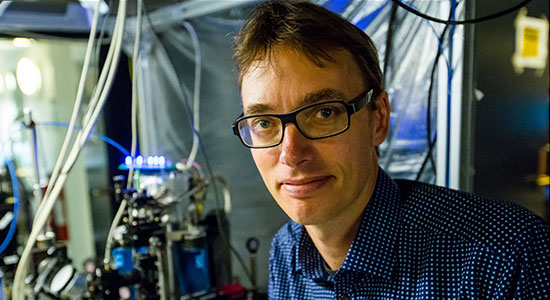
Group leader
Peter Lodahl, Professor
Phone: +45 35 32 53 06
Email: lodahl@nbi.ku.dk
Google Scholar:Link